✔ Check out Day 1 first for the full context! 👇
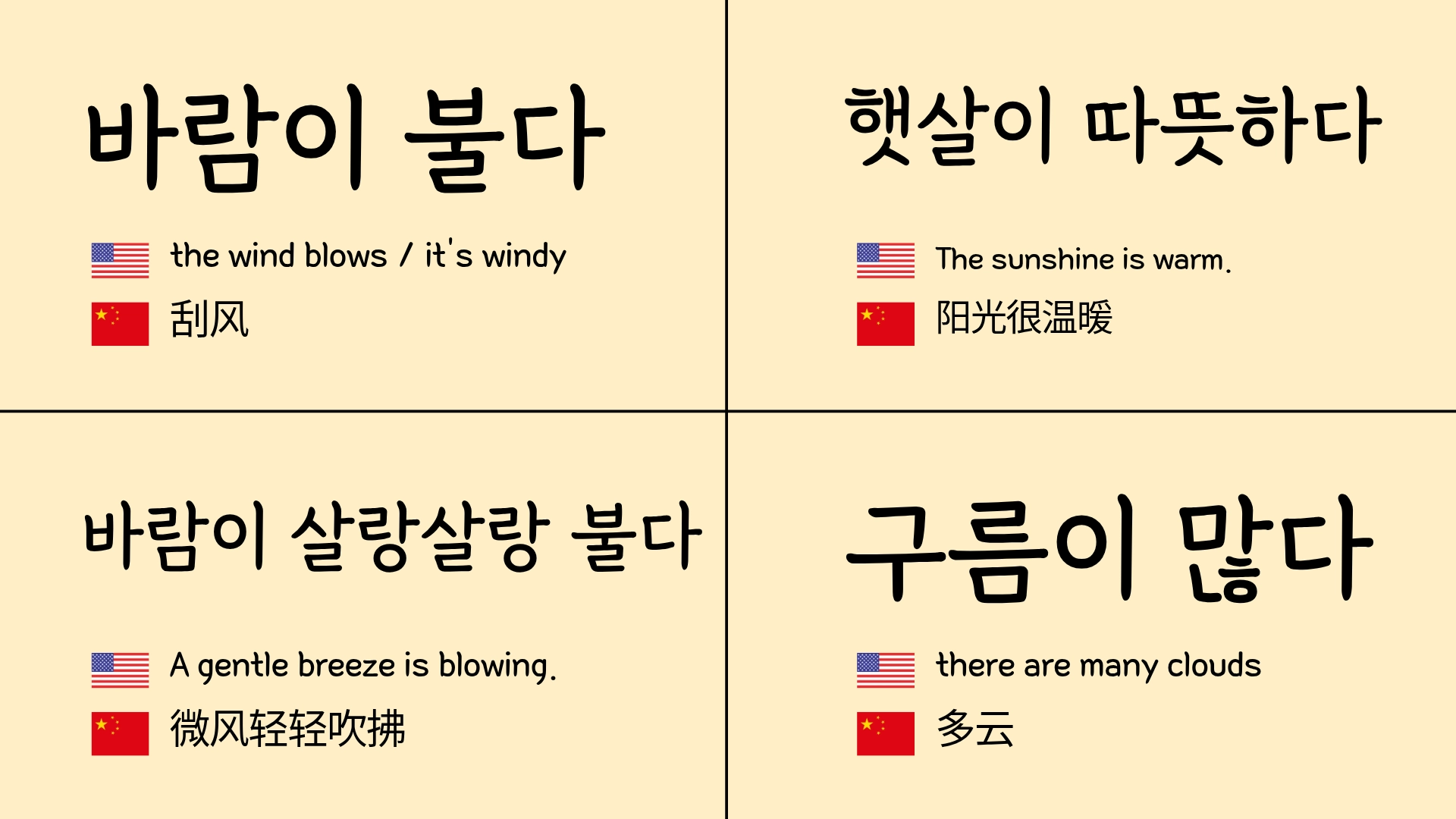
1.  (ba-ram-i bul-da)
Meaning: Air moves to create wind (The wind blows).
[Examples]
 (ba-ram-i ma-ni bu-reo-yo) / It’s very windy. (The wind is blowing a lot.)
 (ba-ram bun-da) / The wind is blowing.
[Dialogue]
- A:
 (nal-ssi eo-ttae-yo) / How is the weather?
 - B:
 (ba-ram-i bu-reo-yo) / The wind is blowing.
[Word Tips]
- Since
 is a verb, it changes its form to
  .
. - Unlike adjectives, verbs represent an ‘action’ or a ‘process’.
2.  (haet-sal-i tta-tteut-ha-da)
Meaning: The sunlight feels warm (The sunshine is warm).
[Examples]
 (haet-sal-i tta-tteut-hae-yo) / The sunshine is warm.
 (haet-sal-i jeong-mal tta-tteut-ha-da) / The sunshine is really warm.
[Dialogue]
- A:
 (bak-kke eo-ttae-yo) / How is it outside?
 - B:
 (haet-sal-i tta-tteut-hae-yo) / The sunshine is warm.
[Word Tips]
 (sunshine) has a softer and more poetic nuance than
  (sunlight).
- It is a common expression used when describing pleasant spring weather.
3.  (ba-ram-i sal-lang-sal-lang bul-da)
Meaning: A gentle, light wind blows pleasantly (A gentle breeze blows).
[Examples]
 (ba-ram-i sal-lang-sal-lang bu-reo-yo) / A gentle breeze is blowing.
 (o-neul ba-ram-i sal-lang-sal-lang bun-da) / A soft breeze is blowing today.
[Dialogue]
- A:
 (o-neul nal-ssi eo-ttae-yo) / How is the weather today?
 - B:
 (ba-ram-i sal-lang-sal-lang bu-reo-yo) / A gentle breeze is blowing.
[Word Tips]
 is an onomatopoeia/mimetic word that describes the way a soft breeze blows.
- This is frequently used to express the pleasant feeling of spring weather.
4.  (gu-reum-i man-ta)
Meaning: A state where there are many clouds (It’s cloudy).
[Examples]
 (gu-reum-i ma-na-yo) / There are many clouds.
 (gu-reum man-ta) / It’s cloudy.
[Dialogue]
- A:
 (ha-neul eo-ttae-yo) / How is the sky?
 - B:
 (gu-reum-i ma-na-yo) / There are many clouds.
[Word Tips]
- ❌
 / ✔
/ ✔ 
- Do not add
 to
to  . The sentence is already complete with the polite ending
  .
. - Use only when using the plain/base form (e.g.,
 ).
).