You met audiences through a group exhibition held this past March at H.art1 in Euljiro. What did you focus on most while preparing for the exhibition?
I continue to develop my work based on the concept of “human desire,” exploring how such desire reveals each individual’s attitude toward life.
For this exhibition, my primary focus was on carefully selecting representative works that could clearly communicate the flow of each series.
In particular, I expanded my folk painting series into a digital format through a large media wall measuring 12 meters wide and 2.4 meters high. This was a meaningful attempt to extend traditional painting into a new digital medium.
Through this process, I aimed to present my work in a more layered and multidimensional way, allowing viewers to experience it beyond a single visual plane.
H.art1 is a space with a strong public and open energy. What kind of first impression did you hope to leave on viewers encountering your work there for the first time?
I believe H.art1 is a space where the distance between the audience and the artwork naturally expands, allowing for a broader field of view. In that sense, it provides an effective environment for presenting my work.
In this space, I hoped viewers would first be drawn to color, which is one of the most important formal elements in my practice. The vivid, lively palette is intended to create an immediate visual attraction, naturally guiding people closer to the work.
Then, as they spent more time looking closely, I wanted them to discover something beyond the surface image, namely a more substantial underlying theme: the human attitude toward life itself.
You have been widely loved for your characters “Mayo” and “Mato,” but recently you made a notable shift by placing traditional subject matter such as Hojakdo at the center of your work. Was there a specific moment that led to this change?
In July 2023, I had the opportunity to participate in Korean Art London at the Mall Galleries in London. Since it was a relatively large-scale international exhibition, I naturally began thinking more deeply about how to express Korean identity in a clearer and more defined way.
That process led me to develop my “folk painting” series. Among them, I chose Hojakdo as a starting point, which later expanded into the “Hojakdo in the House” series.
My intention was to reinterpret traditional folk painting through my own visual language and reintroduce it within the context of contemporary art. In this exhibition, I selected key works that best represent that trajectory and presented them through both painting and media-based works.
In your Hojakdo works, the background is no longer a traditional mountain landscape, but instead everyday domestic spaces. What motivated this change?
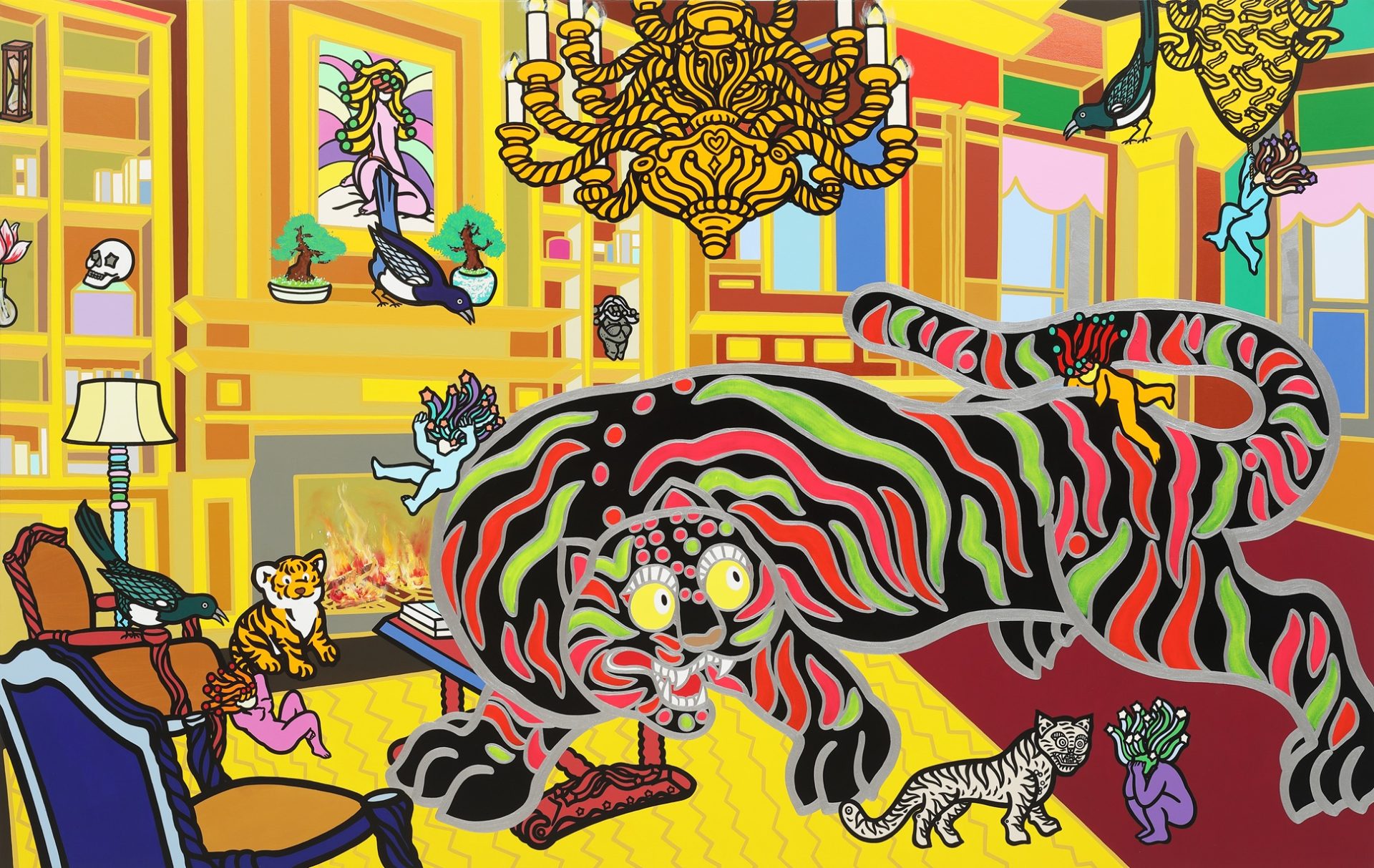
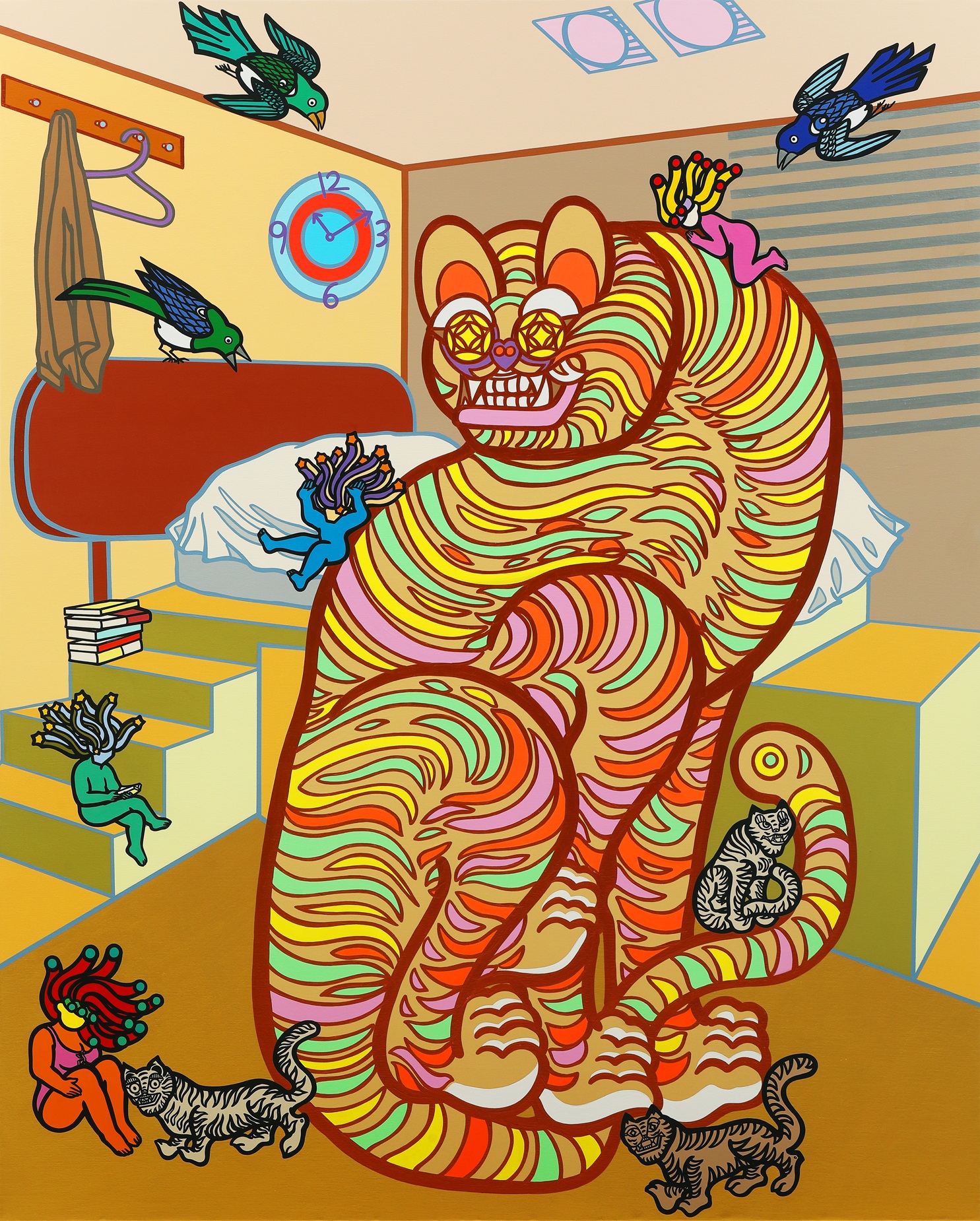
The “Hojakdo in the House” series is a reinterpretation of Hojakdo, a traditional Korean folk painting motif, relocated into contemporary domestic environments.
Traditionally, Hojakdo depicted magpies and tigers together against a backdrop of pine-covered mountains, carrying symbolic meanings such as satirical commentary on authority and ritualistic wishes for good fortune.
In my work, I wanted to shift these motifs into various interior spaces of the home, thereby expanding their meaning into the context of present-day life.
In this setting, the tiger entering the home represents social issues or real events that we encounter in everyday society. I aim to express different human responses to such events through the gestures of distinct characters.
In this sense, the tiger appears in multiple forms: sometimes as a threatening presence, and at other times as a protective figure watching over the subject. Through this duality, it becomes a symbolic device that reflects how we perceive and respond to the events unfolding around us.
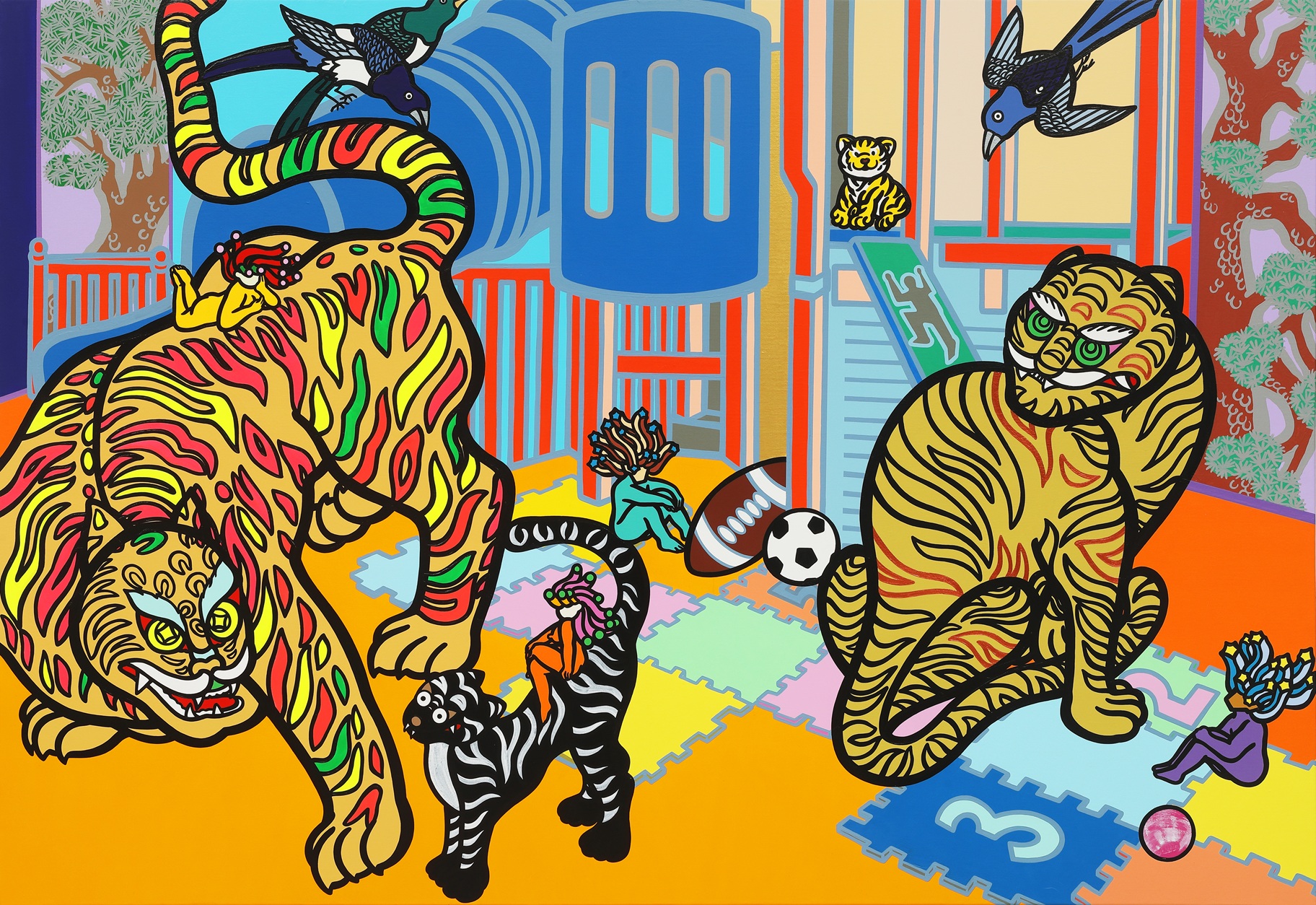
Your signature smooth, bold black lines create a striking sense of unity when paired with the tiger’s stripes. Was it difficult to reinterpret traditional folk painting techniques into your own pop-art language?
Rather than conveying messages in a heavy or didactic way, I choose to let them be perceived intuitively through visual imagery.
Accordingly, instead of faithfully replicating the brushwork of traditional folk painting, I aim to translate it into a contemporary visual language using clear, assertive lines and vivid colors.
At the same time, I design the images in my work so that they can be interpreted allegorically by each viewer, rather than consumed in one fixed way.
Although they may appear light and playful on the surface, I intend for them to prompt viewers to reflect on their own present lives and question how they relate to the world around them.
For this reason, I avoid defining facial expressions too specifically, leaving space for the audience to project themselves into the scene.
Ultimately, I hope my work does not settle into one fixed meaning, but instead remains open-ended, like a film whose ending is completed differently by each viewer’s interpretation.
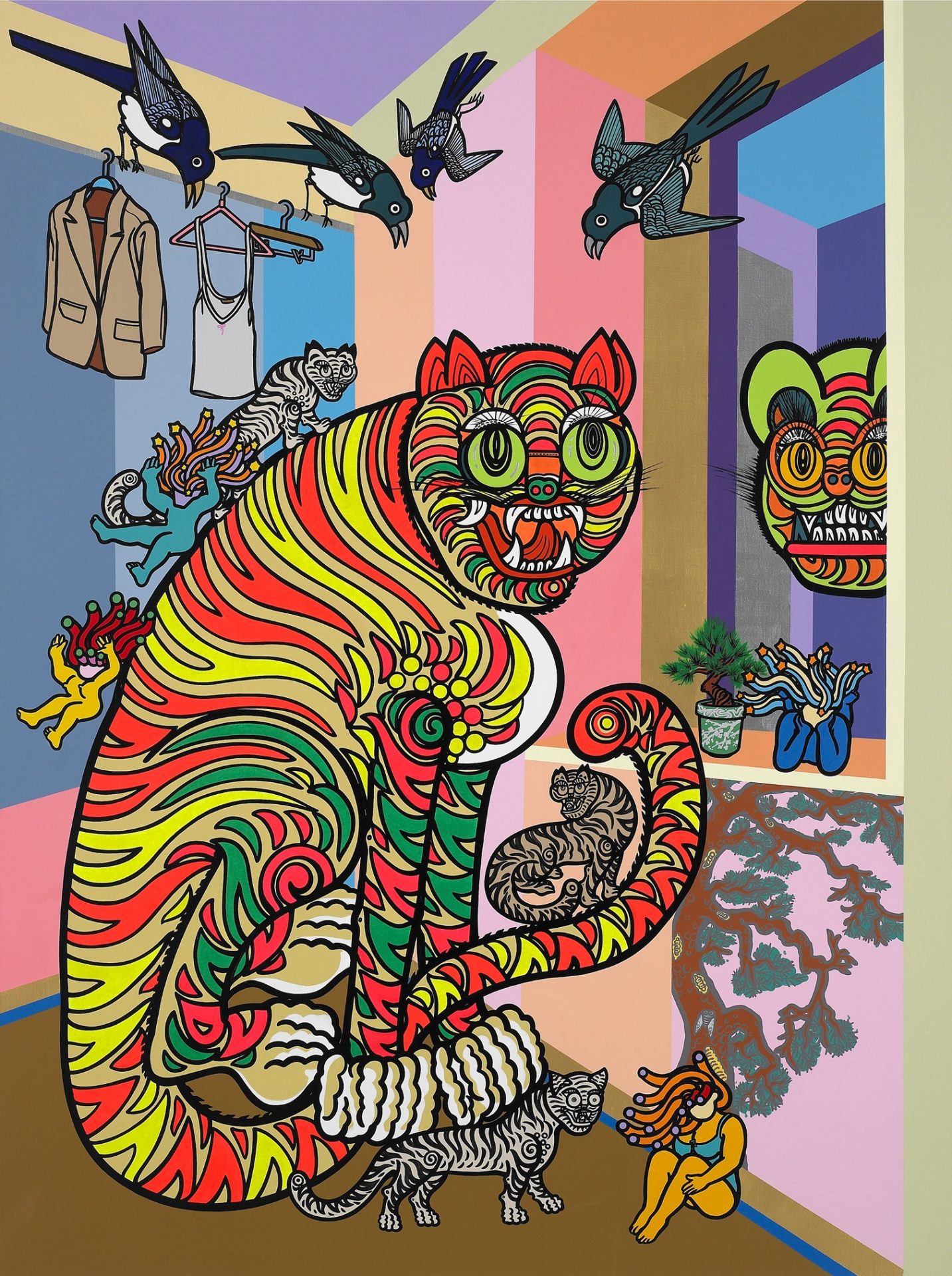
In traditional Hojakdo, the magpie symbolizes good news. What kind of positive energy did you hope viewers would take away from seeing the magpies in your H.art1 exhibition?
In traditional Hojakdo, the magpie is a sign of good fortune, while also carrying a subtle layer of satire toward the authority represented by the tiger.
In my work, I interpret the tiger as a kind of “event” or “situation.” Within that framework, the magpie represents the hope that such situations will ultimately move toward a positive resolution.
It also embodies the idea that an individual’s attitude and choices in response to those situations can lead them toward a brighter, more constructive direction.
Through the magpie, I hope viewers are able to discover small moments of hope, relief, or uplifting energy within their own circumstances as well.
“Modernizing folk painting” can easily become cliché. Do you think your unique sense of wit and humor is what keeps your work from becoming conventional?
I believe traditional visual elements carry symbolic meanings that have been shaped over a long history.
Rather than simply reproducing them as they are, I am more interested in expanding their meaning within the context of contemporary art.
By reinterpreting folk paintings that our ancestors once kept close as objects of wish and aspiration, I aim to reconstruct them into images that resonate with today’s sensibility.
In that sense, my practice is both a way of introducing Korean folk painting to a global audience and a continuous process of expanding my own visual language.
During your H.art1 exhibition, was there a memorable moment or feedback from visitors that stayed with you?
One of the most memorable moments was meeting the CEO of “KoreaNow” in person at the H.art1 exhibition.
They introduced their platform as a meaningful media outlet that shares Korean regional culture and content with international audiences, which made the encounter feel even more significant and welcoming.
I was also deeply impressed by their genuine early interest in my work.
Since I have long been interested in the contemporary reinterpretation and global potential of traditional Korean visual elements, this meeting felt especially meaningful to me.
At a time when Korean culture, including K-pop, dramas, and film, is receiving global attention, I also hope that traditional visual arts such as folk painting can naturally expand and evolve by merging with contemporary sensibilities.
Your constant transformation as an artist is striking. Beyond Hojakdo, are there other traditional motifs or themes you would like to reinterpret in your own style?
My work with folk painting began with Hojakdo and has since expanded into Sipjangsaengdo.
I see the themes embedded in Sipjangsaengdo, such as longevity, health, and well-being, not as values confined to the past, but as expressions of universal human desires that continue today.
In contemporary society as well, similar aspirations are manifested through various systems and industries, including healthcare, medical technology, cosmetics, and lifestyle products.
In that context, I aim to reinterpret Sipjangsaengdo not simply as a traditional image, but as a visual language that reflects contemporary desires.
Ultimately, I hope my work can function as a channel that evokes positive energy and aspiration for the viewer.
You successfully concluded your March exhibition. Could you share your upcoming plans for fans who are looking forward to your new work this year?
I am currently preparing for a solo exhibition in June.
This new body of work begins with an observation of contemporary viewing habits in museum spaces, particularly how people often engage with famous artworks not through deep looking, but through the act of “having seen them,” or consuming them as images for documentation and social display.
I became interested in this ironic and somewhat humorous situation, where viewers stand in front of artworks yet do not truly look at them.
In these works, the figures within the paintings do not function as passive viewers. Instead, they often interrupt the act of looking or insert themselves into it, acting as elements that disrupt traditional modes of spectatorship.
Through this approach, I aim to critically reveal contemporary desires and the changing ways in which we experience visual culture.
Ultimately, this series raises a question about how the act of “seeing” itself has been transformed into a form of consumption in today’s society.
The CEO of KoreaNow personally conducted this exclusive interview.