✔ Check out Day 1 first for the full context! 👇
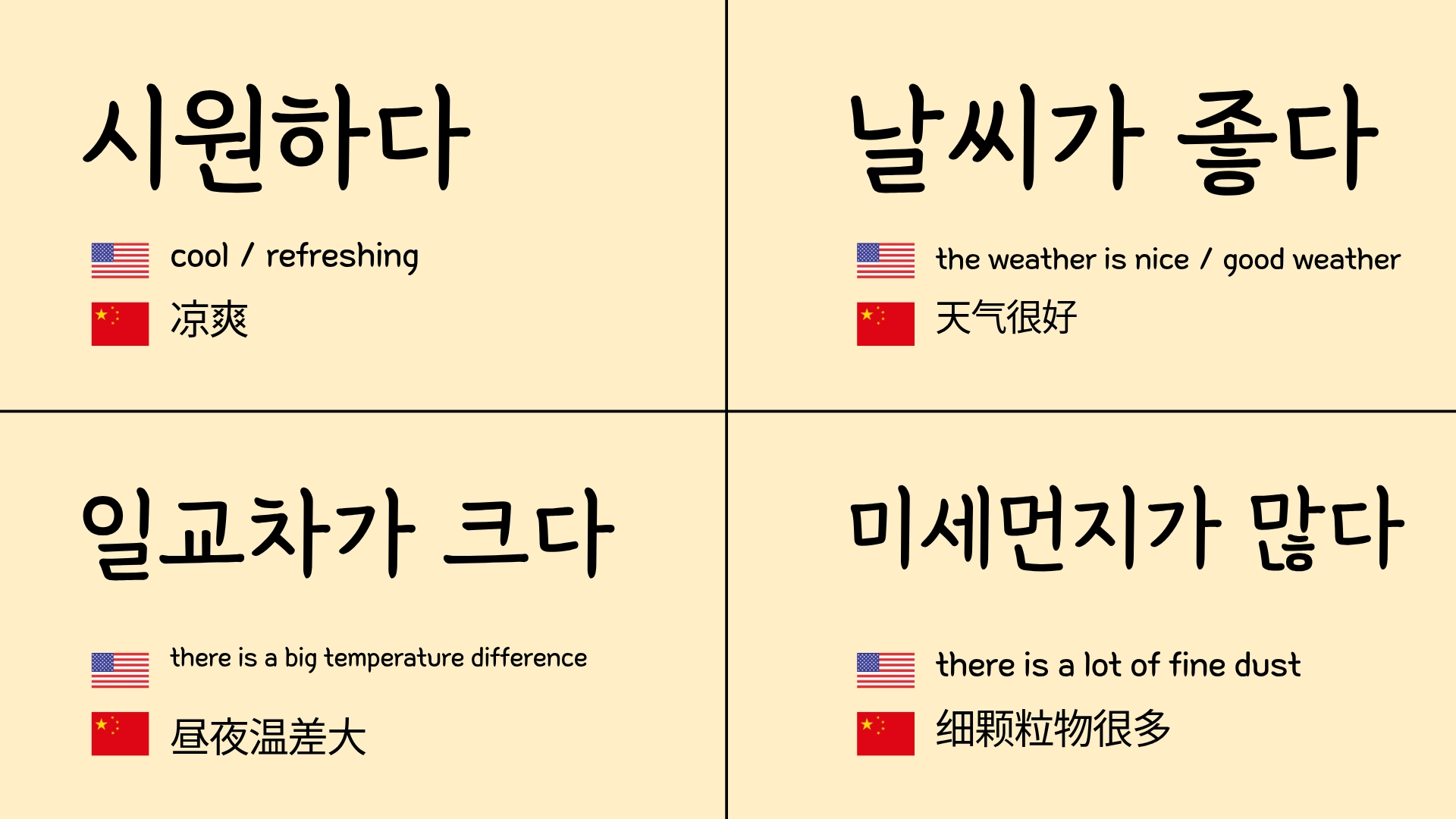
1.  (si-won-ha-da)
Meaning: To feel cool and refreshing, not hot (Cool/Refreshing).
[Examples]
 (ba-ram-i si-won-hae-yo) / The breeze is cool.
 (o-neul si-won-ha-da) / It’s cool today.
[Dialogue]
- A:
 (bak-kke eo-ttae-yo) / How is it outside?
 - B:
 (si-won-hae-yo) / It’s cool.
[Word Tips]
- ❌
 / ✔
/ ✔ - Since
 is an adjective, you cannot use
  .
. - Adjectives ending in
 change to the
  form, like
  .
. - This expression can be used not only for weather but also for food or feelings.
2.  (nal-ssi-ga jo-ta)
Meaning: The weather condition is good (Nice weather).
[Examples]
 (nal-ssi-ga jo-a-yo) / The weather is nice.
 (o-neul nal-ssi jo-ta) / The weather is good today.
[Dialogue]
- A:
 (nal-ssi jon-ne-yo) / The weather is nice, isn’t it?
 - B:
 (geu-reo-ge-yo) / I agree. (Indeed.)
[Word Tips]
- It is conjugated as
 .
. - Remember that Korean adjectives change their form depending on the situation or the level of politeness.
3.  (il-gyo-cha-ga keu-da)
Meaning: There is a large temperature difference between day and night.
[Examples]
 (il-gyo-cha-ga keo-yo) / There’s a big daily temperature range.
 (il-gyo-cha keu-da) / The daily temperature range is large.
[Dialogue]
- A:
 (o-neul wae i-reo-ke chu-wo-yo?) / Why is it so cold today?
 - B:
 (il-gyo-cha-ga keo-yo) / There’s a big temperature difference between day and night.
[Word Tips]
- It changes from
 .
. - It’s helpful to remember the
 vowel drop rule: when the stem ends in and meets
  , the is dropped.
4.  (mi-se-meon-ji-ga man-ta)
Meaning: A state where the air is murky and unhealthy (Fine dust levels are high).
[Examples]
 (mi-se-meon-ji-ga ma-na-yo) / There is a lot of fine dust.
 (o-neul gong-gi an jo-ta) / The air quality is bad today.
[Dialogue]
- A:
 (mi-se-meon-ji eo-ttae-yo) / How is the fine dust?
 - B:
 (an jo-a-yo) / It’s bad.
[Word Tips]
 changes to
  (and
(and  becomes
  ).
).- ‘Fine dust’ (
 ) is a very frequently mentioned weather-related topic in Korea, especially during spring and winter.