
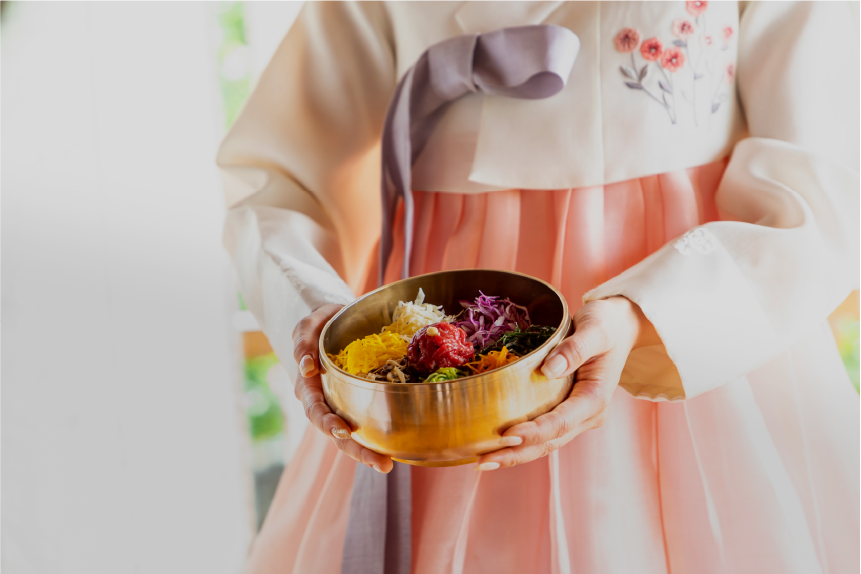
1. From the Wisdom of Harmony to a Global Culinary Icon
(From Survival & Harmony to Global Gourmet: The Philosophy of Bibimbap)
October in Korea is a season of abundance. Beneath mountains painted in brilliant shades of crimson and gold, the year’s harvest reaches its joyful culmination. It is during this season that Koreans gather nature’s finest ingredients into a single bowl, gently mixing them together to celebrate the generosity of autumn.
Bibimbap, one of the most iconic dishes in Korean gastronomy, is far more than a mixture of rice and vegetables. It embodies the rhythms of the four seasons, the Eastern philosophy of Yin and Yang and the Five Elements, and the spirit of harmony that has long shaped Korean communities.
Eumbok and Field Meals: The Philosophy Behind Mixing Together
For generations, the act of mixing rice with various side dishes represented much more than a practical way of eating—it reflected a philosophy of life.
One of its origins can be found in the tradition of Eumbok, the ritual sharing of food offered during ancestral memorial ceremonies. Families would gather to eat the rice, vegetables, and pancakes that had been presented to their ancestors, symbolizing the equal sharing of blessings between the spiritual world and the living, and among the members of the community themselves.
Another tradition emerged from Korea’s agricultural villages. During rice planting and harvest seasons, farmers brought whatever side dishes they had prepared from home and emptied them onto one large communal tray. Everyone shared the meal together, regardless of status or wealth, creating what became known as deulbap, or “field meals.”
Today, this humble yet profound culture of sharing has evolved into one of Korea’s most beloved culinary traditions. Through Jeonju—designated by UNESCO as a Creative City of Gastronomy—bibimbap has become an internationally celebrated symbol of healthy eating, sustainability, and the Slow Food movement.
The Science Behind the Five Colors and Five Flavors
Every topping placed on a bowl of bibimbap carries purpose and meaning.
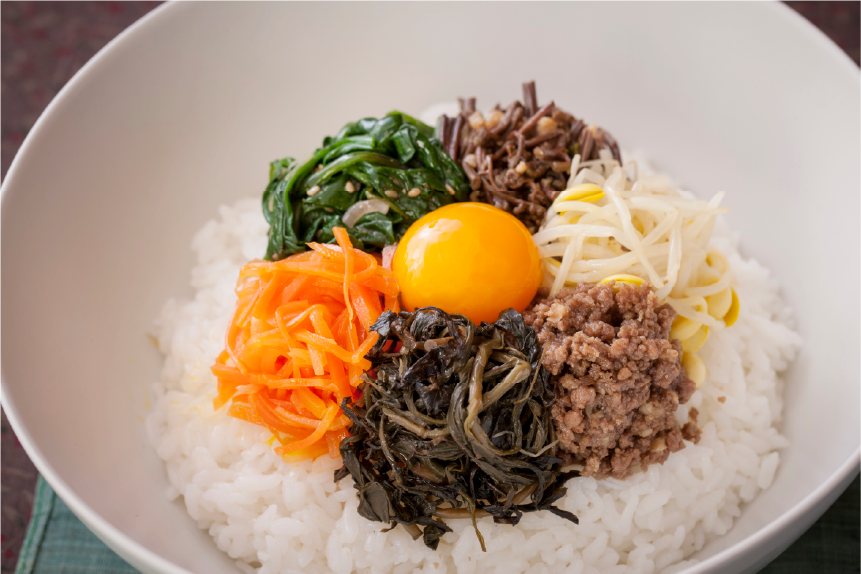
Green ingredients such as water parsley and zucchini, red chili paste and seasoned beef, yellow egg yolk and hwangpomuk (mung bean jelly dyed with gardenia fruit), white bean sprouts and steamed rice, and black shiitake mushrooms and bracken fern together form the Five Colors (Obaeksaek).
These colors correspond to the Five Elements in traditional East Asian philosophy—wood, fire, earth, metal, and water—as well as the body’s five vital organs, reflecting the belief that balanced colors contribute to balanced health.
When these colorful ingredients are gently mixed together with gochujang and fragrant sesame oil, they create more than visual beauty. The combination enhances the nutritional value of each ingredient while producing the harmonious balance of the Five Flavors—sweet, sour, salty, bitter, and umami—that defines the essence of bibimbap.
2. History & Literature: The Authentic Origins of Bibimbap
[Etymology & Historical Records: From ‘Goldongban’ (骨董飯) to ‘Bubyeumbap’]
Throughout history, bibimbap has appeared in Korean literature under a variety of names.
- 15th-century Gijae Japgi (己齋雜記): In the writings of the mid-Joseon scholar Park Dong-ryang, the story of Jeon Im (田霖), a former magistrate of Jeonju, mentions Hondonban (混沌飯), a dish made by mixing fish and vegetables with rice. This suggests that the custom of mixing rice with side dishes was already widespread during the early Joseon period.
- Late Joseon Silhak literature: In the writings of Yi Ik (李瀷) and other scholars, the term Goldongban (骨董飯) appears. The word goldong originally referred to a collection of miscellaneous objects, symbolizing the practical wisdom of combining various vegetables and side dishes with rice into a single meal.
- Late 19th-century cookbook Siuijeonseo (是議全書): This is the first historical document in which bibimbap appears under its vernacular Korean name. While the dish is written as Goldongban in Chinese characters, it is accompanied by the Korean spelling Bubyeumbap. The cookbook describes a detailed recipe featuring rice topped with seasoned beef, pan-fried delicacies, sautéed vegetables, fried kelp, and other colorful garnishes, finished with chili powder, toasted sesame seeds, and sesame oil before mixing together. The recipe is regarded as the direct prototype of modern bibimbap.
[Jeonju Bibimbap: The Pinnacle of Modern Korean Culinary History]
Jeonju Bibimbap evolved from a regional specialty into a signature restaurant dish in the late 1890s, when it first appeared in eateries around Jeonju’s traditional marketplace. In 1952, shortly after the Korean War, a dedicated Korean restaurant opened near Jeonju Hanok Village, establishing the city’s distinctive seasoning methods and bean sprout steaming technique. In 2011, restaurants specializing in Jeonju Bibimbap were introduced in the Korean edition of the Michelin Guide, solidifying the dish’s international standing.
[Signature Dish: The Art of Bone Broth Rice and Hwangpomuk]
If you have the opportunity to enjoy Jeonju Bibimbap, take a moment to appreciate the craftsmanship behind its preparation.
■ The Secret to the Rice: Instead of plain water, the rice is cooked in rich beef bone broth, allowing every grain to absorb a deep umami flavor. Just before the rice is fully cooked, Jeonju’s signature bean sprouts are added and steamed, preserving their crisp texture.
■ Signature Topping – Hwangpomuk: Hwangpomuk, a golden mung bean jelly colored naturally with gardenia fruit, is an essential ingredient of Jeonju Bibimbap. Its soft, springy texture provides a delicate contrast to the vegetables.
■ The Warmth of Yugi Brassware: Traditionally served in a preheated yugi (Korean brass bowl), the dish stays warm at approximately 60–70°C throughout the meal, allowing the seasonings to blend naturally.
3. Jeonju Bibimbap Festival 2026: A Celebration of Korea’s Culinary Heritage
[Origin & Heritage]
The Jeonju Bibimbap Festival began in 2007 under the name Jeonju Millennium Feast of Flavors. Created to introduce Jeonju’s rich culinary traditions, abundant local ingredients, and the spirit of sharing embodied by bibimbap, the festival was renamed the Jeonju Bibimbap Festival in 2010 and has since grown into one of Korea’s leading international food festivals.
The festival also played an important role in Jeonju’s designation as Korea’s first UNESCO Creative City of Gastronomy in 2012. More than a food event, it has become a cultural celebration of Korea’s four seasons and the philosophy of harmony represented by the Five Colors and Five Flavors.
[Festival Overview]
Hosted by Jeonju City, the Jeonju Bibimbap Festival 2026 celebrates Jeonju’s status as a UNESCO Creative City of Gastronomy while offering visitors an opportunity to experience the beauty of traditional Korean cuisine through all five senses. (Based on the official announcement by Jeonju City)
- Festival: Jeonju Bibimbap Festival 2026
- Dates: October 2 (Fri) – October 4 (Sun), 2026 (3 days)
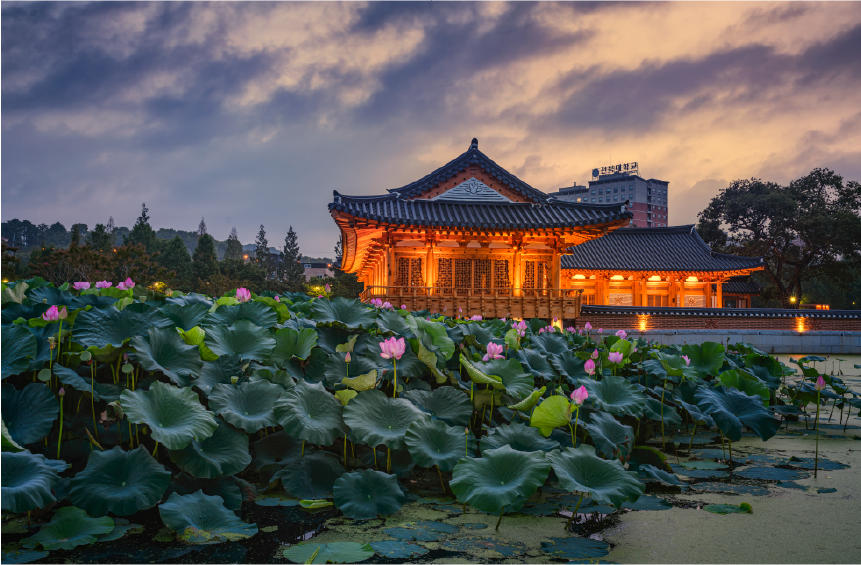
- Venue: Deokjin Park, Jeonju
- Host: Jeonju City
[Three Must-See Highlights]
1) Giant Bibimbap Performance
The festival’s signature program invites visitors to take part in the preparation of an enormous bibimbap. Participants stir the giant cauldron together using oversized paddles, symbolizing harmony and sharing.
2) Jeonju Gourmet Zone
Featuring authentic Jeonju Bibimbap alongside a wide variety of regional specialties, the food zone showcases Jeonju’s finest culinary traditions through carefully prepared dishes, elegant presentation, and high standards of quality and hygiene.
3) Jeonju Bibimbap Photo Zone
Inspired by Deokjin Park’s scenic landscape, a visually captivating photo spot is created. It harmonizes with the vibrant five-color aesthetics of Jeonju Bibimbap.
4. Transportation: How to Get to the 2026 Jeonju Bibimbap Festival (Deokjin Park) from Seoul
(The Ultimate Transportation Guide)
Jeonju has a well-developed public transportation system. However, the festival venue, Deokjin Park, is located in the northern part of the city rather than near Jeonju Hanok Village. For international visitors and first-time travelers, here are the most efficient and straightforward routes.
The most important tip is to take transportation bound for Deokjin Park or Jeonbuk National University, not buses heading to Jeonju Hanok Village.
Option A. The “Speedy & Easy” KTX Route: High-Speed Rail + Local Bus
This is the fastest and most convenient option for travelers who value speed and punctuality.
- From Seoul: Depart from Yongsan Station or Seoul Station (Subway Line 1 or Gyeongui–Jungang Line). If departing from southern Seoul, Suseo Station (SRT) is also available.
- Train: Take the KTX Jeolla Line to Jeonju Station. (Approx. 1 hr 30 min–1 hr 50 min)
- KTX Schedule & Fare (Yongsan → Jeonju):
- Frequency: 1–2 trains per hour (First train: 05:08 / Last train: 21:48)
- Fare: KRW 34,400 (Standard Class, one way)
- Secret Tip: KTX trains departing from Yongsan Station operate more frequently than those from Seoul Station.
- From Jeonju Station:
- Taxi: Take a taxi from the station taxi stand. (Approx. 10–15 min / KRW 7,000–9,000)
Option B. The “Scenic & Budget” Train Route: ITX-Saemaeul / Mugunghwa
A classic rail option for backpackers and travelers who prefer enjoying the scenery along the way.
- From Seoul: Depart from Yongsan Station.
- Train: Take an ITX-Saemaeul (ITX-Maum) or Mugunghwa train bound for Jeonju.
- Travel Time & Fare:
- ITX-Saemaeul / ITX-Maum: Approx. 3 hr–3 hr 10 min / KRW 26,200 (one way)
- Mugunghwa: Approx. 3 hr 30 min–3 hr 50 min / KRW 17,600 (one way)
- Secret Tip (Mugunghwa Hack): The Mugunghwa fare is about half the price of the KTX. Weekend tickets often sell out 1–2 weeks in advance. If you prefer power outlets and more spacious seating, ITX-Maum is recommended.
- From Jeonju Station: Take a taxi to Deokjin Park, as with the KTX route.
Option C. The “Local Hack” Bus Route: Express Bus + Walk/Taxi
The express bus terminal is considerably closer to Deokjin Park than Jeonju Station, making this a practical and economical option.
- From Seoul: Depart from Central City Terminal (Honam Line) at Express Bus Terminal Station (Subway Lines 3, 7, and 9).
- Bus: Take an express bus to Jeonju Express Bus Terminal. (Approx. 2 hr 40 min)
- Schedule & Fare:
- Frequency: Every 10–20 minutes (05:00–24:00)
- Fare: Standard KRW 15,000 / Excellent KRW 22,000 / Premium KRW 28,600 (one way)
- Secret Tip (Walkable Distance): The bus terminal is much closer to Deokjin Park than Jeonju Station. On a pleasant October day, you can enjoy a leisurely walk to the festival.
- From the Bus Terminal to the Festival:
- Taxi: Approx. 7 min / KRW 4,500–5,500
- On Foot (Recommended): About 1.8 km to the main entrance of Deokjin Park via Jeonbuk National University. Approx. 30 min.
- City Bus: Take Bus 5002 from the ‘Express Bus Terminal·Bulgyo Hoegwan’ stop and get off at ‘Girindaero Deokjin Park’. (Approx. 15 min / KRW 1,700)
A Bowl of Perfect Harmony: Discover It in Jeonju
Bibimbap, recorded throughout history as Hondonban and Bubyeumbap, has evolved through the lives of ordinary people and Korea’s modern culinary history into much more than a simple meal. Just as ingredients with different colors, flavors, and textures come together in one bowl to create perfect harmony, bibimbap symbolizes Korea’s climate, agricultural traditions, and aesthetic philosophy.
Building on this remarkable culinary heritage, Jeonju launched the ‘Jeonju Millennium Feast of Flavors’ in 2007, which evolved into the Jeonju Bibimbap Festival in 2010 and helped establish the city’s reputation as a UNESCO Creative City of Gastronomy.
From October 2 to October 4, 2026, Deokjin Park will host the 2026 Jeonju Bibimbap Festival, where visitors can experience the grandeur of the Giant Bibimbap Performance, the authentic flavors of the Jeonju Gourmet Zone, and picturesque photo spots set against the park’s beautiful autumn scenery.
Easily accessible from Seoul by public transportation, the festival offers a chance to experience the authentic flavors preserved by Jeonju for centuries and to discover the true meaning of harmony embodied in a single bowl of bibimbap.