
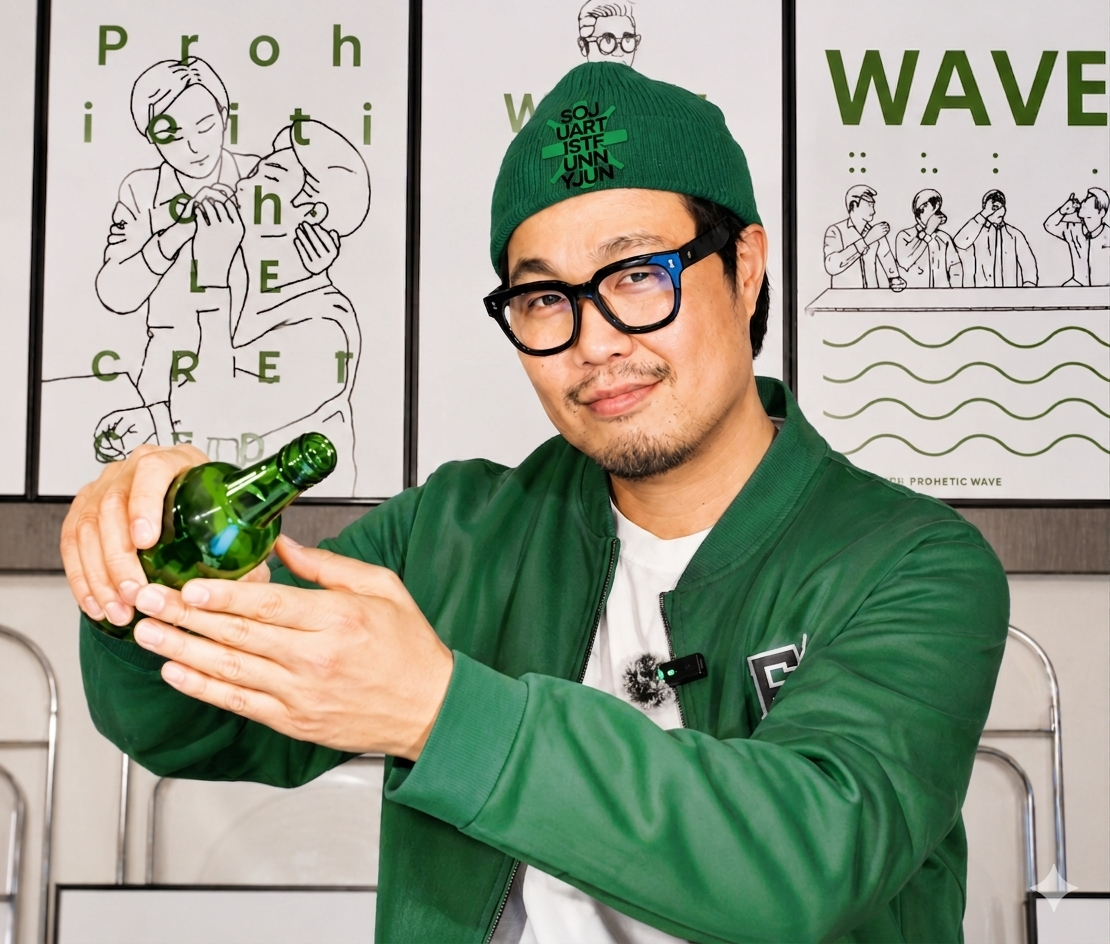
Funnyjun (WANJUN KIM) is a visual artist who has expanded soju, one of Korea’s most familiar and distinct cultural symbols, into the realm of pop art and visual culture. Through contemporary aesthetics and wit, he explores the ups and downs of everyday Korean life and the cultural sentiment of jeong—the deep emotional bonds and sense of affection that connect people.
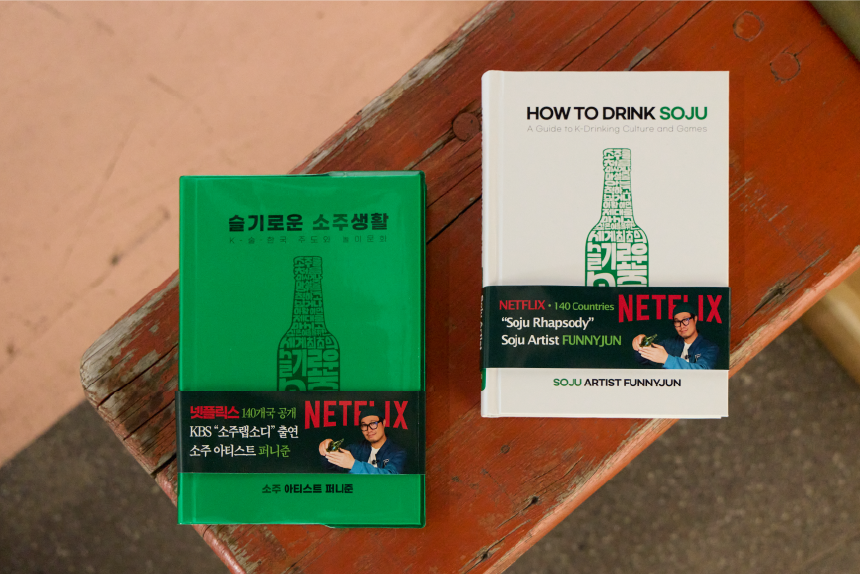
In 2021, he published Alangmalang Soju Tamgu Saenghwal, the world’s first book exploring Korea’s traditional drinking culture and etiquette, showcasing his distinctive identity as a “soju artist.” Ever since, he has continued exhibitions and cultural projects across Japan, Europe, and Southeast Asia. Following his appearance on Netflix’s Soju Rhapsody in 2025, he further advanced his global activities with the 2026 publication of the English-language edition, HOW TO DRINK SOJU: A Guide to K-Drinking Culture and Games.
Through books, paintings, exhibitions, and diverse cultural projects, Funnyjun introduces the world to Korea’s unique drinking etiquette and the values of consideration that embed jeong within it. Through the warmth of comfort found in a glass of soju and the empathy that connects one person to another, he delivers a witty yet tender message that resonates across many cultures.
Q1. You have established a unique path as a “soju artist,” elevating such an everyday drink into the realm of art. Beyond being simply an alcoholic beverage, what artistic message or metaphor does soju represent to you?
A1. I believe soju is a symbol of a unique form of Korean humanity—something invisible, yet deeply present. In Korea, asking someone, “Would you like to have a glass of soju?” is rarely just about drinking. It can mean, “I want to get to know you better,” “It’s been a long time—let’s catch up,” “I want to have an honest conversation with you,” or even, “I’m having a hard time these days. Shall we talk about life together and relieve some of our stress?” A single invitation can carry countless meanings.
I believe life itself is art. More specifically, our everyday lives are art. For an artist, art is a way of expressing one’s thoughts; for an audience, it is a source of empathy and comfort. In that sense, soju is life itself.
Q2. Through your book HOW TO DRINK SOJU and related exhibitions, you have introduced Korean drinking culture to international audiences and received an enthusiastic response. Looking back, how has this project become an important turning point in your artistic journey?
A2. It was an enormous turning point. (Laughs.) My earlier work was largely a kind of stream of consciousness. I had wanted to attend art school but, for various reasons, never did. So the artistic impulse inside me remained as a kind of anger from childhood—a lingering sense of resentment and rebellion against the mainstream.
But working as a soju artist gave my art an opportunity to attract public attention while also reaching a much broader audience. Unlike many other professions, an artist is said to be irreplaceable. If someone can simply be replaced, perhaps they are not really an artist—but something more like a pair of Nike shoes? Or perhaps a Birkin bag, with its enormous mass appeal.
There is only one soju artist in the world, and there is a singular message that comes with that identity. That realization gave me even greater confidence—confidence in my artistic world and in the reason I continue this work.
Q3. Korean drinking etiquette—such as pouring alcohol with both hands or turning one’s head while drinking—can seem remarkably distinctive to international audiences. What aspects of Korean jeong and the “aesthetics of consideration” do you most want to highlight through these customs?
A3. Before simply defining them as distinctive cultural practices, I wanted to ask: Why do we pour alcohol with both hands? Why do we turn our heads when we drink? I became fascinated by the reasons behind these behaviors. Yet it is difficult to find definitive answers because no one historically recorded why these customs began. Someone must have started them at some point. Whatever the original reason may have been, I became interested in the phenomenon itself.
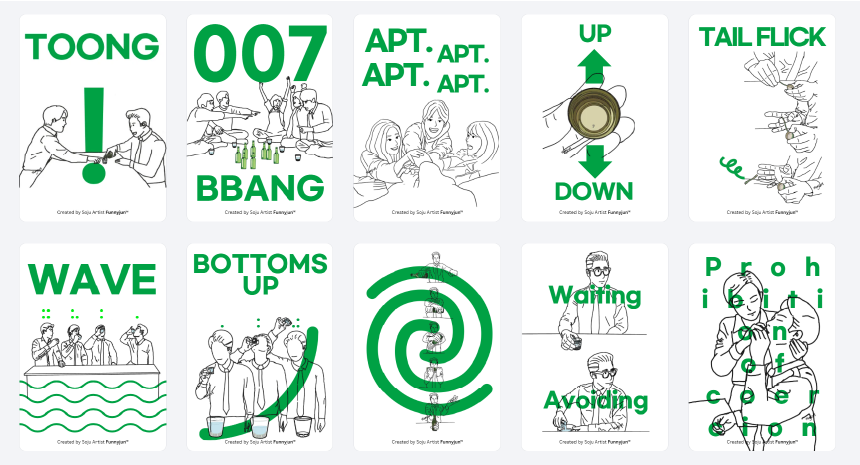
Rather than trying to emphasize a particular message about drinking or drinking etiquette, I felt a strong desire to examine and document these behaviors. Things we take for granted can easily pass by like natural phenomena. But if they are actually social phenomena, I believe we can discover much more within them. That, in itself, is important.
For international visitors who want to better understand Korea, I do believe that learning about Korean dining etiquette and drinking culture can help them understand the jeong and consideration embedded in Korean culture.
Q4. As K-content continues to gain global popularity, the international perception of K-soju is also evolving. Is there a particularly memorable reaction or episode from an overseas reader or audience member who encountered your work and your message about Korean drinking culture?
A4. To be honest, I never planned large-scale overseas exhibitions. I simply traveled to different countries and looked for places where I could exhibit. Yet every time, I met people who genuinely loved my work.
It all began with people such as Pony, who gave me an exhibition opportunity in Bangkok’s Siam Square; Pear, who created an opportunity for me to exhibit in Vientiane, Laos; Nat, who runs Warehouse Paint Club in Chiang Mai; Phuc at Complex01 and Paddy Tran’s Hang in Hanoi, Vietnam; Anoto in Japan; and local friends in Spain and Portugal who helped me organize guerrilla performances.
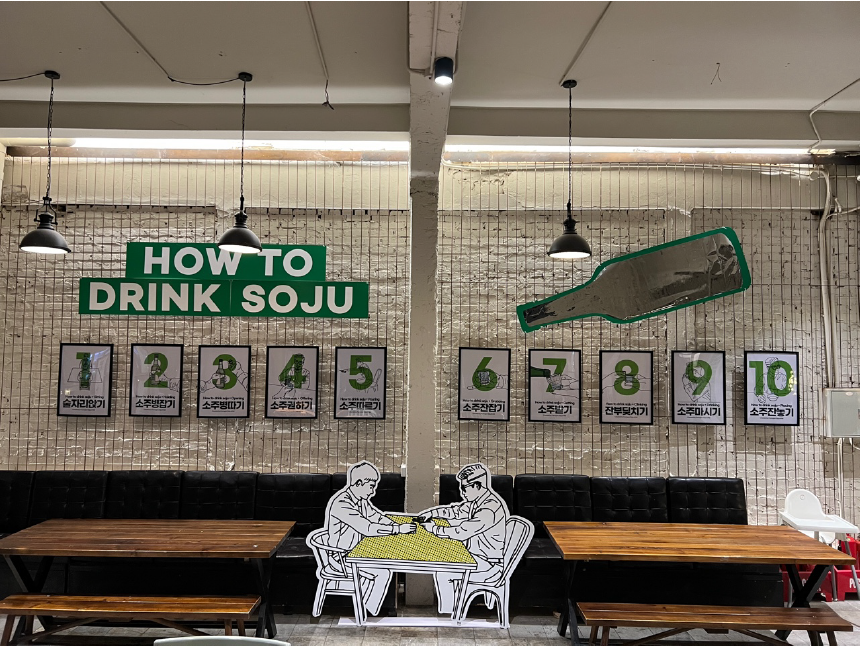
I am deeply grateful to all of these people. They took an interest in Korean culture, believed in my passion, and gave their time, money, and energy to help me hold exhibitions, install my work, and introduce it to others. Their support has meant a great deal to me.
Q5. Your iconic “Soju Artist” character and witty pop-art style make the subject of soju feel both approachable and visually engaging. When creating your work, what do you pay the most attention to, particularly when using the green color of the soju bottle or developing your characters?
A5. The most important principle I have in creating art is: “Let’s communicate just one thing.”
I also find it difficult to remember many things after looking at a work of art or reading a book. In the end, what remains within me is usually a single impression or message that I received from that work. So rather than trying to communicate too much with the audience, I aim to leave a clear story in each piece.
For me, green is an important device that helps audiences remember that one story. Green is my personal symbol and a visual clue that allows viewers to intuitively understand and remember my work. At the same time, it connects multiple works into a single universe and serves as the signature that most distinctively represents my identity as Funnyjun.
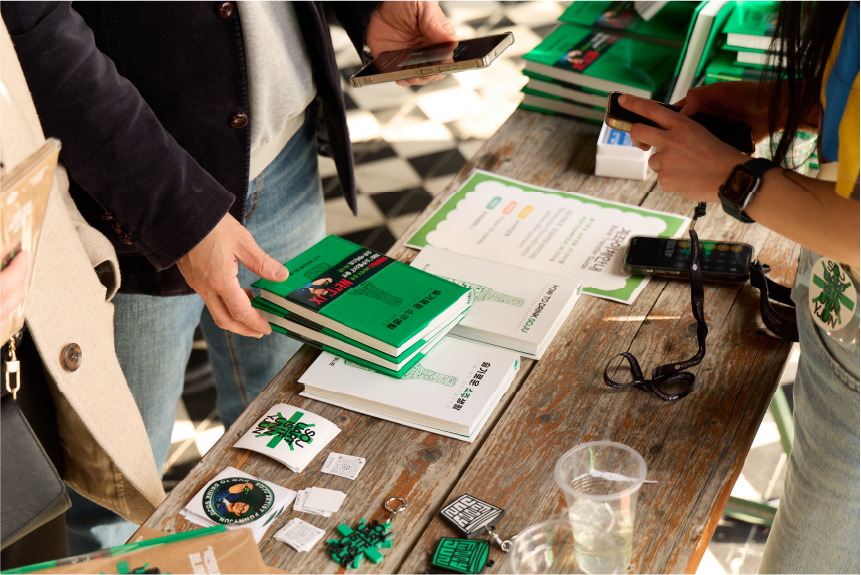
So in my work, green is more than just a color. It is a language that conveys the story of the work, leaves an impression in the viewer’s memory, and connects each piece to my own artistic universe.
Q6. Unlike glamorous and expensive spirits or wine, the humble green bottle of soju has a unique ability to gently comfort Koreans during their loneliest and most difficult moments. As a soju artist, what do you see as the popular aesthetic and emotional warmth of soju?
A6. Simply put, our soju is inexpensive. Because of this, there can be a tendency to regard a life spent drinking cheap alcohol as somehow cheap itself. Perhaps that is one reason there has been relatively little artistic exploration of soju, or why there has been less interest in how Korean drinking culture is represented through something as inexpensive as soju.
Yet art has always been directed toward humanity, and history proves this. I believe soju exists within that same context. Expensive spirits and wine, as their names and histories suggest, represent their own historical contexts and ways of life. Soju, on the other hand, is an industrial drink that symbolizes the development of South Korea. I particularly love the idea of describing it as an “industrial spirit” representing the blood, sweat, and labor of workers.
I do not know what its future will look like, but as an industrial drink, soju was an integral part of the lives of the Baby Boomer generation and continues to have a profound influence on Korean sentiment today. That is precisely why it provides such a powerful source of inspiration for me as an artist.
Q7. Your work often evokes personal drinking memories and moments from the lives of individual viewers. When you place stories onto a canvas, what value do you consider most important in creating a sense of empathy with your audience?
A7. When people look at my work, I hope each person recalls an episode from their own life. Hopefully it is a good memory, although it may not always be. I believe that is the moment when a connection with my work begins to form.
I can actually recognize the moments when viewers find that point of connection. Most of them smile and say, “Exactly. That’s right.”
Q8. This fall issue of the magazine explores the deep history of traditional Korean liquor and the beauty of Chuseok culture. From traditional spirits that take days to brew to the soju enjoyed by people today, how do you view the spectrum of Korean drinking culture and its potential for artistic evolution?
A8. I believe the spectrum of Korean alcohol is limitless. I find great hope in seeing traditional Korean liquor producers working so hard to establish and express their own individual voices.
Some people argue that diluted soju interferes with that movement, but I believe the two can coexist in different areas. My own approach is to engage with soju as part of Korean culture within that coexistence.
As more breweries and distilleries invest in and develop Korean drinking culture, I believe the possibilities for my own artistic evolution will also continue to grow. I am looking forward to many collaborations. I plan to create them one by one.
Q9. What kind of visual and emotional inspiration does autumn, a season where abundance and loneliness coexist, offer you as a contemporary artist? Is there a particular “glass of soju on an autumn day” that you would recommend to readers enjoying your work this season?
A9. Honestly, autumn is the season that inspires me the most.
Rather than being flamboyant, it feels like a somewhat shy final stage—a season that invites you to look back at yourself before everything completely fades. That feeling of reflection at the end of a cycle feels very much like me.
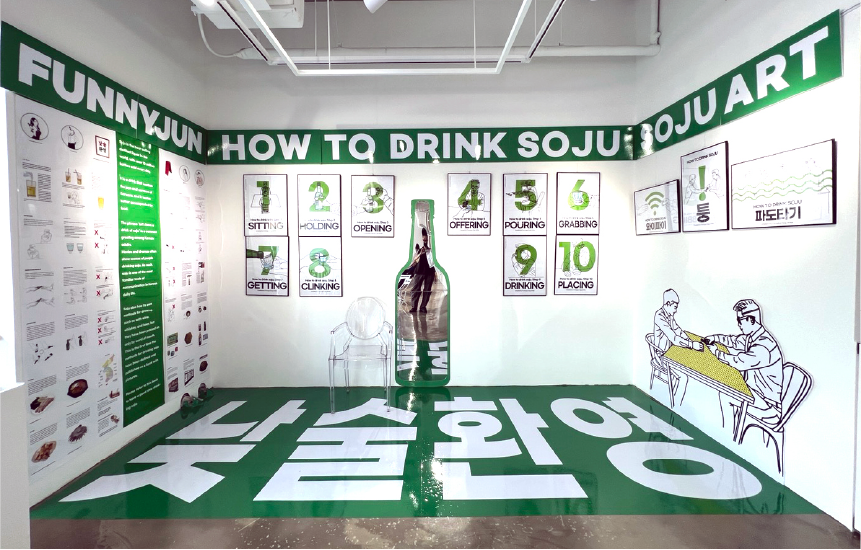
A glass of soju in autumn…
I graduated from Sungkyunkwan University, one of the oldest universities in Korea. Founded in 1398, it has an extraordinary history. On campus stands a ginkgo tree that is more than 600 years old. Among all the seasons, when its leaves turn golden in autumn, I feel a sense of impermanence and reflection. It feels like the perfect setting for a glass of soju while taking a moment to look inward.
Q10. Are there any new projects or expansions of your artistic universe that you would like to explore on the global art stage? Finally, what words of warm comfort would you like to share with readers of our fall issue as an artist?
A10. My artist name is Funnyjun, and I am a soju artist. My real name is Kim Wanjun, and I am also the CEO of Proudcomm Inc., an AI-based PR and marketing company.
I hope to combine the originality and foresight I possess as an artist with the persistence and ability to amplify ideas that I have developed as the CEO of Proudcomm, and use that synergy to share the appeal of K-culture with a wider audience.
If you are interested in collaborating with me, please feel free to say hello. Shall we create and spread Korean culture together?
Instagram: @funnyjun_
Email: funnyjun@gmail.com
Website: sojuartist.com / proudcomm.com