
Craft & Heritage Technology
Iridescent Elegance: How the 400-Year-Old Light of Tongyeong’s Sea Inspires a Global Lifestyle
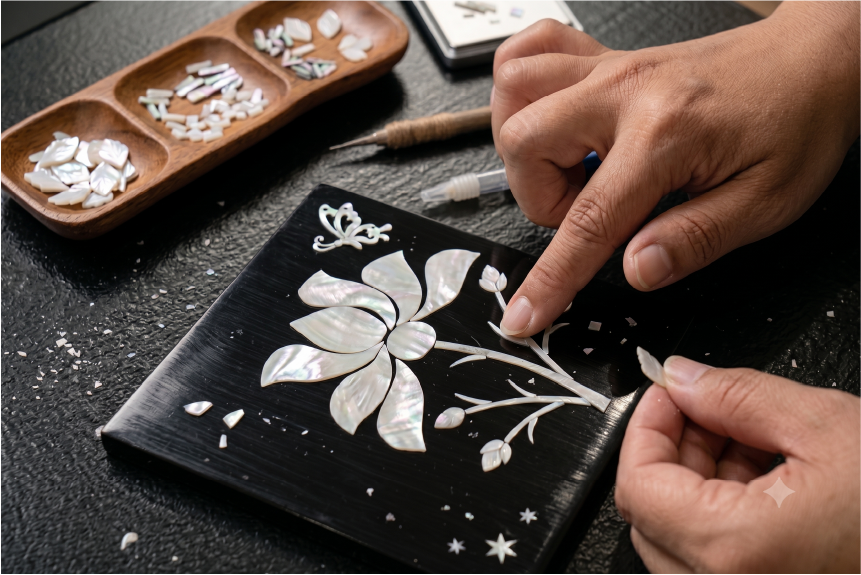
A single abalone shell, shaped by years beneath the deep waters of Korea’s southern coast. Refined by the artisans whose craft allows no more than a 0.1-millimeter margin of error, it is reborn as a radiant work of art—bringing timeless beauty to the desks and wallets of people around the world.
[PROLOGUE]
The Alchemy of Mother-of-Pearl Beyond the Museum
Museums are places of quiet contemplation. Behind carefully controlled glass displays, where temperature and humidity preserve centuries of history, exquisite mother-of-pearl lacquerware from Korea’s Joseon Dynasty has long remained untouched. Dressing tables, chests, and decorative boxes adorned with phoenix motifs once reflected the elegance of the royal court and Korea’s noble families, admired only as precious relics of the past.
Today, however, mother-of-pearl has stepped beyond the museum’s silence.
What was once considered a historical treasure has found new life in the vibrant landscape of the twenty-first century.
From the trendsetting neighborhoods of Seongsu and Hannam in Seoul to high-end design studios in New York and Paris, and even on the desks of creative professionals around the world, Korean mother-of-pearl craftsmanship is experiencing a remarkable renaissance. Traditional patterns that once decorated antique family furniture now appear on wireless chargers, card skins, premium audio equipment, and even runway installations at international fashion weeks.
The beauty of mother-of-pearl possesses a depth that artificial screens and LED lights can never replicate. As the viewing angle changes—and as natural light shifts throughout the day—its surface transforms continuously, revealing shades of crimson, emerald, silver, violet, and luminous pink. It seems as though the passage of time itself has been preserved within the shell, carrying with it years of ocean waves and changing seasons.
The world’s growing fascination with Korean mother-of-pearl extends far beyond its visual beauty. Its true value lies in the extraordinary combination of nature and craftsmanship. Created from abalone shells shaped by the sea and lacquer harvested from mountain lacquer trees, every piece embodies remarkable patience, meticulous precision, and generations of artisanal expertise. It is, quite literally, an alchemy of time and perseverance.
Once reserved for the splendor of Korea’s royal court, this iridescent art form has now evolved into one of the most distinctive expressions of contemporary Korean lifestyle design. From its origins along the shores of Tongyeong more than four centuries ago to its modern reinterpretation by Shellang Korea through sophisticated desk accessories and lifestyle products, the story of Korean mother-of-pearl continues to shine—connecting centuries of tradition with today’s global design culture.
PART A | Historical Roots: Tongyeong, the Birthplace of Korean Mother-of-Pearl Lacquerware
1. The Legacy of the Twelve Workshops: The Naval Headquarters and 400 Years of Tongyeong Mother-of-Pearl Craftsmanship
When people think of Korean mother-of-pearl lacquerware (Najeonchilgi), one place immediately comes to mind: Tongyeong, the picturesque port city on Korea’s southern coast. Revered as the spiritual home of this traditional craft, Tongyeong’s reputation as the epicenter of mother-of-pearl lacquerware dates back more than four centuries to the turbulent years of the Imjin War (1592–1598).
In 1593, Admiral Yi Sun-sin established the Headquarters of the Three Provincial Naval Forces (Samdosugun Tongjeyeong) on Hansan Island to command the naval forces of Jeolla, Chungcheong, and Gyeongsang Provinces. Originally built as a military command center, the headquarters gradually evolved into a thriving production hub. To supply military provisions, create tribute gifts for the royal court, produce official government wares, and support the livelihoods of naval personnel, highly skilled artisans from across the country were brought together. Their collective expertise laid the foundation for what became the renowned Twelve Workshops, the cradle of Joseon’s industrial craftsmanship.
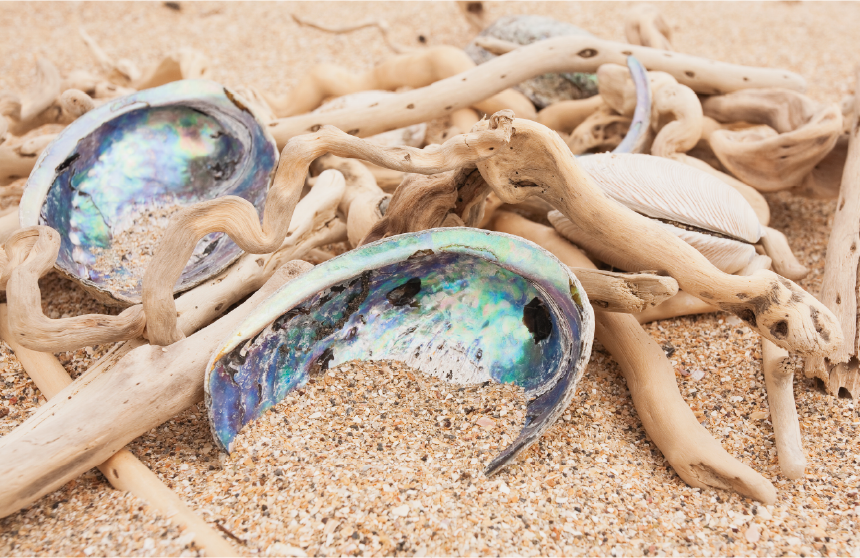
Among these workshops, the most technically demanding were the Chiljeon, dedicated to lacquering, and the Najeonjeon, where artisans specialized in mother-of-pearl inlay. Tongyeong’s mild climate provided the ideal humidity for curing lacquer, while the pristine waters of Korea’s southern coast yielded an abundant supply of high-quality abalone shells—the essential material for mother-of-pearl craftsmanship.
This unique combination of exceptional natural resources and the meticulous skills of the kingdom’s finest craftsmen gave birth to the legendary tradition of Tongyeong mother-of-pearl lacquerware. Decorative boxes, dining tables (soban), and document chests crafted in Tongyeong were presented to the royal court as tribute, while owning a Tongyeong lacquerware piece became a symbol of prestige and prosperity among Korea’s noble families.
Master artisans approached every step with extraordinary precision. Even when polishing a single abalone shell, they carefully considered seasonal humidity and the grain of the wood, creating works so structurally refined that they could retain their brilliance and remain intact for generations without fading or delaminating.
2. Nature’s Perfect Harmony: Abalone, Paulownia Wood, and Lacquer
The enduring beauty of Tongyeong mother-of-pearl lacquerware lies in the harmonious relationship between its natural materials.
Wild abalone living among the rocky waters of Tongyeong’s southern coastline endure powerful currents and changing seasons throughout their lives. As a result, their shells develop exceptionally dense calcium crystal layers, producing the brilliant iridescence known as the “Five Colors” (Ogwang), a luminosity rarely found in shellfish from warmer seas.
Master artisans carefully plane the surface of each shell into paper-thin layers, revealing the precious material known as mother-of-pearl. Every delicate fragment preserves the natural brilliance accumulated through years beneath the sea, transforming an ordinary shell into a gemstone-like artistic medium.
3. The Alchemy of 0.1 mm Precision: Jurumjil, Kkuneumjil, and Tagae-beop
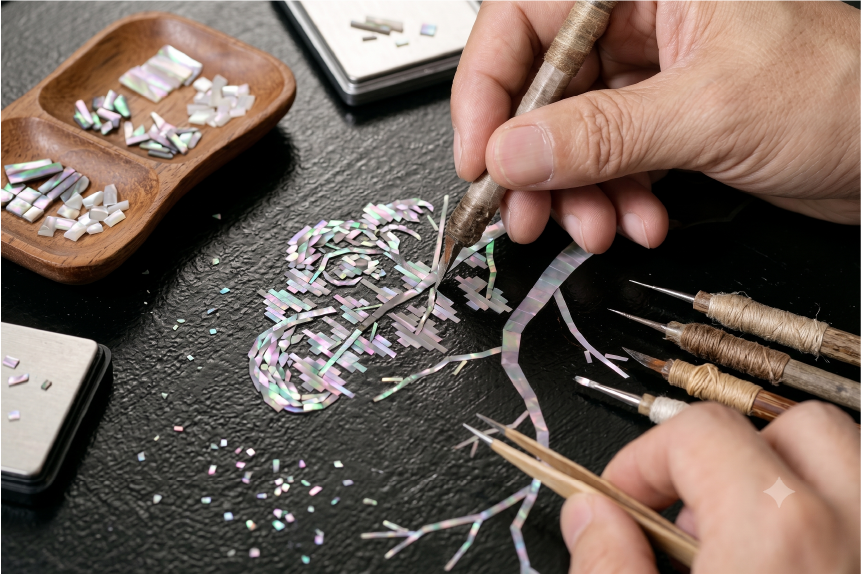
Transforming a single piece of mother-of-pearl into a finished work of art requires dozens of painstaking processes. Every stage demands extraordinary patience, unwavering concentration, and exceptional craftsmanship. Among the many techniques involved, the following three are considered the hallmarks of traditional Korean mother-of-pearl inlay.
- Jurumjil (Curved Sawing)
Jurumjil is a highly skilled technique in which artisans use a fine fretsaw to cut intricate patterns from thin sheets of mother-of-pearl. Whether depicting the sweeping wings of a phoenix, the graceful form of a deer from the Ten Symbols of Longevity, or the layered petals of a peony blossom, every curve must be executed with absolute precision. Even the slightest movement—no more than 0.1 millimeters—can disrupt the balance of the entire design. Each cut is therefore made in complete silence, with steady hands and unwavering focus. - Kkuneumjil (Segmented Inlay)
In Kkuneumjil, artisans slice mother-of-pearl into hair-thin strips before cutting them into tiny segments measuring just 0.5–1 millimeter. These minute pieces are individually placed onto the wooden surface to form intricate geometric patterns such as comb motifs, latticework, and traditional lightning designs. Tens of thousands of tiny fragments are assembled by hand, producing a level of precision reminiscent of digital pixel art—achieved entirely through traditional craftsmanship. - Tagae-beop (Crack Inlay Technique)
Tagae-beop is an advanced technique used to apply mother-of-pearl to curved surfaces. Artisans gently tap the shell with a hammer or blade to create microscopic crack lines, allowing the otherwise rigid material to bend without breaking. These fine fractures also scatter light in countless directions through diffuse reflection, giving the finished surface remarkable depth and a rich, shimmering texture.
Yet attaching the mother-of-pearl marks only the midpoint of the process.
The surface is repeatedly coated with layers of natural lacquer, each layer carefully dried before being polished smooth with charcoal. Finally, artisans hand-buff the piece until a deep, mirror-like sheen gradually emerges. This meticulous cycle of lacquering, sanding, and polishing is repeated over and over, requiring immense patience and precision.
Only when the iridescent shell begins to glow through the glossy black lacquer—appearing almost to float upon its surface—does the true spirit of Tongyeong mother-of-pearl lacquerware finally come to life.
PART B | A Modern Revival: The Mother-of-Pearl Lifestyle
1. Korean Aesthetics Captivating K-Pop and Global Fashion
Once confined to the corners of traditional Korean homes, mother-of-pearl lacquer cabinets have stepped out of history and onto the world stage. Today, this centuries-old craft has become a source of inspiration for internationally acclaimed artists and some of the most influential names in contemporary fashion and design.
Public interest in Korean traditional crafts has grown significantly as cultural figures—including RM of BTS, an avid collector of Korean art—have brought greater attention to the country’s artistic heritage. At the same time, prestigious international events such as Paris Fashion Week, Milan Design Week, and the New York Biennale have showcased furniture, luxury clutch bags, and high-end audio speakers incorporating Korean mother-of-pearl techniques, earning widespread recognition from the global design community.
Against the clean lines of modern Western minimalism, the shimmering, ever-changing iridescence of Korean mother-of-pearl introduces warmth, texture, and a distinctive visual depth. Its ability to reflect a spectrum of colors under changing light has made it one of the most celebrated materials in contemporary luxury design, admired by designers worldwide for its uniquely refined and unmistakably Korean aesthetic.
2. Everyday Luxury: The Rise of the K-Craft Lifestyle
Mother-of-pearl is no longer confined to museum display cases.
A new generation of Korean creators, particularly Generation Z, together with international collectors visiting Korea, are embracing a K-Craft lifestyle that incorporates traditional craftsmanship into everyday living. Rather than being reserved for ceremonial objects, mother-of-pearl has become part of modern interiors and personal accessories.
Popular lifestyle items include:
- Iridescent mother-of-pearl coasters and serving trays that instantly elevate dining tables and coffee tables.
- Elegant business card holders and stationery collections that bring sophistication to home offices and workspaces.
- Pendant lighting and console furniture featuring mother-of-pearl accents, adding distinctive artistic character to contemporary urban interiors.
The warm luster of natural mother-of-pearl is something that mass-produced artificial plastics or cold metal materials can never achieve. Young Korean artisans and designers have combined the iridescent beauty of mother-of-pearl with IT devices that are constantly held in the hands of modern people. This hip revolution of K-Craft perfectly proves that “the most traditional local heritage can become the most modern and global design trend.”
PART C (PARTNER SPOTLIGHT): K-Tech & Craft Presented by KoreaNow
There is a leading brand that has perfectly blended traditional Korean craftsmanship with modern digital accessories. Shellang Korea is a brand that creatively combines natural mother-of-pearl craftsmanship technology with IT lifestyle goods.
Shellang Korea brings the iridescent colors of mother-of-pearl, once crafted in Tongyeong workshops hundreds of years ago, onto your office desk and into your wallet — transforming everyday life into a personal miniature art museum.
1. [Jagaebit] Najeon Soban Wireless Charger – Flower Cheondo Ban
• Heritage Meets Innovation (Joseon Soban Reimagined as a Wireless Charger)
Inspired by traditional Naju Soban, elegant dining tables used in the Joseon Dynasty to carefully serve tea and meals to honored guests, and the graceful architectural curves of the Hojokban (“tiger-legged table”), this product reinterprets Korea’s traditional furniture heritage into a refined miniature object.
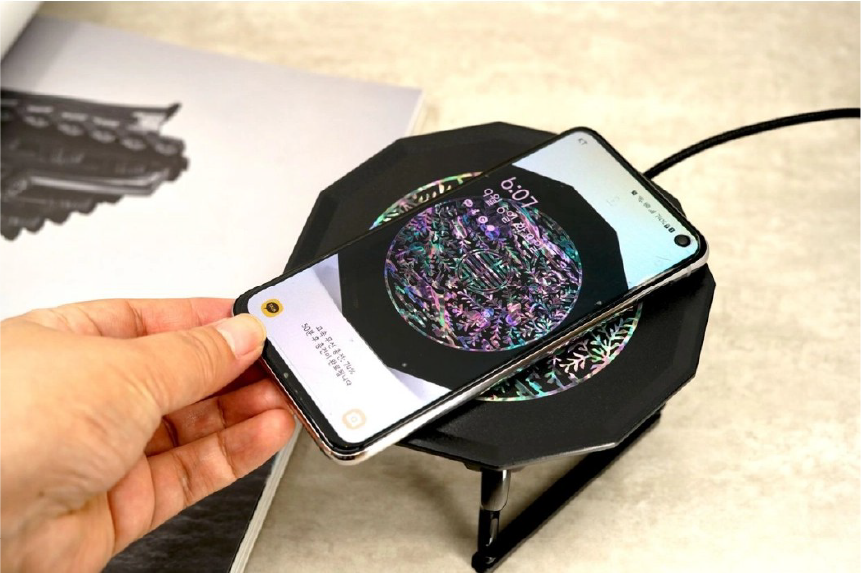
A wooden-legged structure inspired by an antique soban supports a tabletop delicately inlaid with natural mother-of-pearl. As a smartphone rests upon it, the ordinary act of charging is transformed into an intentional, aesthetic ritual — as if receiving energy from a tranquil Joseon-era tea table.
• Cheondo and the Blessings of Sipjangsaeng: An Iconographic Aesthetic
The luminous mother-of-pearl patterns embroidered across the center of the tabletop embody the traditional wishes for longevity, prosperity, and eternal harmony found in Korean heritage artifacts.
Two cranes (Ssanghak, 雙鶴) — symbols of integrity and creatures believed to connect heaven and earth — gracefully soar above a peach tree of immortality (Cheondo, 天桃), representing eternal youth and good health. At the center lies the Chinese character “Su (壽),” meaning longevity, symbolizing everlasting peace and well-being.
Using the naturally iridescent colors of abalone shell, Shellang Korea delicately engraves these symbols of the Sipjangsaeng (Ten Symbols of Longevity). Through meticulous craftsmanship, the three-dimensional texture of peach fruits and the soft lines of crane feathers are brought vividly to life.
When sunlight enters through a window or a smartphone is placed upon the surface, rainbow-like reflections scatter across the tabletop, delivering a quiet message of comfort, blessing, and harmony in everyday moments.
• The Essence of Desk-terrior
On a busy urban office desk or bedside table, the Flower Cheondo Ban Wireless Charger goes beyond being a simple IT accessory. It becomes a sophisticated desk-terior object that defines the aesthetic atmosphere of an entire space.
Every time you charge your smartphone, you can experience the calm reflective energy of a 400-year-old Korean tradition.
2. Premium Mother-of-Pearl Card Sticker – PearlPass Skin (7 Designs)
• Wearable K-Craft (Natural Mother-of-Pearl in Your Wallet)
This innovative fashion sticker collection transforms everyday items — such as credit cards, transportation cards, debit cards, and building access cards — into personalized pieces of Korean craft art by simply attaching a layer of genuine mother-of-pearl design.
• Seven Iconic K-Heritage Collections
Featuring the unique textures and subtle reflections of natural mother-of-pearl, this designer collection presents seven different interpretations of Korean heritage symbols and colors.
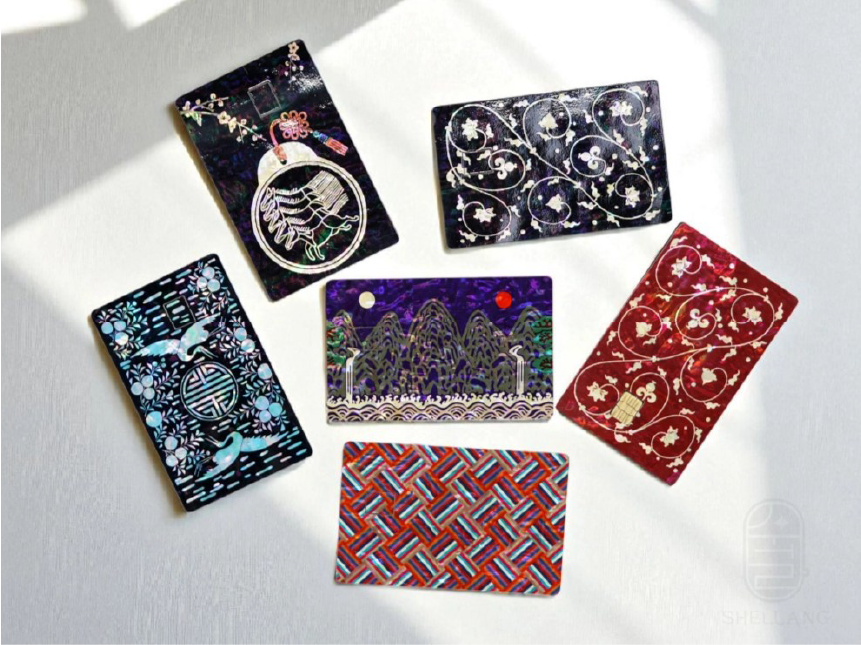
1. Irworobongdo (日月五峯圖) – The Sun, Moon, and Five Peaks
The ultimate expression of royal court aesthetics, symbolizing the dignity of kingship and a peaceful, prosperous era.
2. Mapae (馬牌) – Royal Horse Insignia
A symbol of justice, authority, achievement, and good fortune, traditionally associated with secret royal inspectors.
3. Ssanghak (雙鶴) – Two Cranes
Representing grace, longevity, and the aspiration for noble character through the image of two cranes soaring through the sky.
4. Peony Pattern – Red Peony
A vibrant and passionate floral design symbolizing wealth, honor, and harmonious relationships.
5. Peony Pattern – Black Peony
A refined interpretation of prosperity, featuring elegant peonies blooming against a deep black background.
6. Saekdong Pattern
A harmonious expression of Korea’s traditional five-directional colors, believed to ward off misfortune and invite blessings.
7. Blue Tiger
A playful yet powerful interpretation of the tiger, symbolizing courage, protection from negative energy, and dynamic strength.
• The Ultimate K-Souvenir for Global Travelers
Every moment you take out your card from your wallet or tap your transportation card, you can experience the shimmering beauty of Korean mother-of-pearl at your fingertips.
Compact, lightweight, and highly portable, PearlPass Skin captures the premium emotional value of Korean traditional craftsmanship, making it a beloved keepsake and gift among international visitors to Korea.
[BUYING GUIDE FOR GLOBAL READERS]
🛍️ Official Culture Mall Guide
The premium Shellang Korea collections featured in this article — “[Jagaebit] Najeon Soban Wireless Charger – Flower Cheondo Ban” and “Premium Mother-of-Pearl Card Sticker PearlPass Skin (7 Designs)” — are available through KoreaNow, the official culture commerce platform introducing Korea’s finest cultural goods to global audiences.
- Official Distributor: KoreaNow
- Services Provided: Safe global shipping and premium K-Craft packaging support
- Cultural Value: Every product guarantees the harmony between 400 years of Tongyeong Najeon Chilgi (mother-of-pearl lacquerware) craftsmanship and modern IT technology.
[EPILOGUE] When 400 Years of Ocean Light Illuminates Your Everyday Life
From abalone shells that endured the powerful waves and deep waters of Korea’s southern coast, to their transformation into radiant works of art through the meticulous and patient hands of artisans — Najeon Chilgi carries layers of history, nature, and time within its craftsmanship.
Once confined behind the cold glass displays of museums, mother-of-pearl has now been reborn through Shellang Korea’s creative vision. It begins a new story of light on our desks, at our fingertips, and inside our everyday wallets.
The moment you gently place your smartphone onto the Najeon Soban Wireless Charger, or take out the rainbow-colored PearlPass Card from your wallet, you encounter the cool ocean breeze of Tongyeong from 400 years ago and the passionate dedication of Joseon-era craftsmen.
Through the official KoreaNow Culture Mall, these small yet exquisite objects of iridescent beauty offer more than ownership of a refined product — they create a meaningful connection with the spirit and soul of Korea’s 400-year-old craft heritage.
Countless trends and dazzling artificial lights eventually fade with time. Yet the radiant colors of Korean mother-of-pearl, created through the collaboration of nature and time, remain eternal.
May this traditional light, carried across centuries and now entering your everyday life, bring warmth, elegance, comfort, and inspiration to the world you live in today.