
1. Saturi (Dialect)
Saturi (dialect) refers to the distinct variations of a language used in different regions within a country. While the meaning remains the same, the pronunciation, intonation, and vocabulary can vary.
In Korea, there are major dialects for regions such as Chungcheong-do, Jeolla-do, Gyeongsang-do, Gangwon-do, and Jeju-do. Each regional dialect shows differences in speech speed, accent, and ways of expression.
2. Regional Dialect Characteristics
? Chungcheong-do
- Speech is relatively slow and gentle.
- The intonation is not very strong.
- Expressions like “~yeo (
 )” or “~kke (
 )” are frequently used.
? Jeolla-do
- The intonation is clear and rhythmic.
- Expressions like “~ing (
 )” or “~rangkke (
 )” are common.
 - It gives off a warm and friendly impression.
? Gyeongsang-do
- There is a large variation in pitch (highs and lows).
- The speech tends to be fast.
- Distinct expressions include “~dei (
 )” and “~aiga (
 )”.
)”.
? Gangwon-do
- The intonation is not very strong and is relatively composed.
- There are significant regional differences within the province (between the Yeongdong and Yeongseo areas).
- Some areas still preserve archaic words or unique vocabulary.
- In some cases, the end of a sentence is drawn out longer.
3. Korean dialect – 1️⃣ Chungcheong-do Dialect
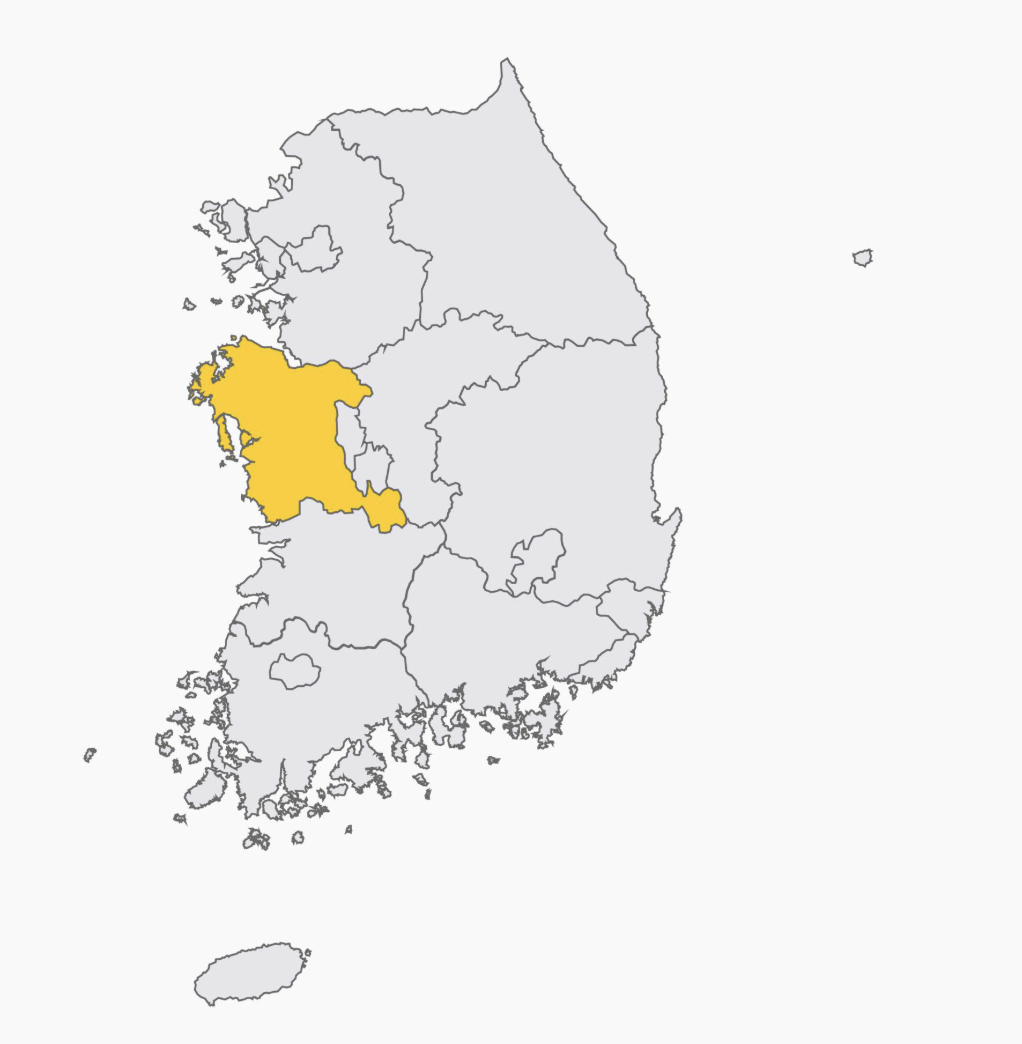
Chungcheong-do is located in the central region of South Korea, situated between Seoul and the southern regions. It is divided into two provinces: Chungcheongnam-do and Chungcheongbuk-do. Additionally, Daejeon Metropolitan City and Sejong Special Self-Governing City are also part of the Chungcheong region.
4. Famous Attractions in Chungcheong-do)
- Boryeong-si : A city famous for the Boryeong Mud Festival. It is home to Daecheon Beach.
- Gongju-si : A city rich in Baekje historical sites. Gongsanseong Fortress and the Royal Tomb of King Muryeong are well-known.
- Jecheon-si : A city with beautiful natural scenery. Cheongpungho Lake and Uirimji Reservoir are famous landmarks.
5. Chungcheong-do Dialect Words
 (Naeng-gida) : To leave something behind without using it all. (Standard:
  – Nam-gida)
 (Dun-nwo) : To lay one’s body down. (Standard:
  – Nu-wo)
 (Jjeom-maeda) : To tie or bind tightly with a string or rope. (Standard:
  – Muk-da)
 (Syeo-boda) : To count numbers one by one. (Standard:
  – Seyeo-boda)
 (Jeo-bun) : A tool used to pick up food. (Standard:
  – Jeot-garak / Chopsticks)
 (Gyeo-ran) : An egg laid by a hen. (Standard:
  – Gye-ran / Egg)
 (Ggae-gurakji) : An amphibian animal that lives on both land and in water. (Standard:
  – Gae-guri / Frog)
 (Daegan-hada) : To be very tired and exhausted. (Standard:
  – Godan-hada)