A UNESCO-Recognized Masterpiece in Search of the Crimson Voice
“Do you know Pansori?”
Lately, on the streets of Seoul, around university districts, and across YouTube, we have been witnessing scenes that feel both unfamiliar and strangely captivating: a blond international student snapping open a fan and, in clumsy Korean, shouting, “Come here, let me carry you and play!” Or a theater in Paris rising to its feet after a Korean sorikkun completes a four-hour wan-chang, a full, uncut performance.
If K-pop, embodied by BTS and BLACKPINK, is Korea’s present, then foreigners are now beginning to seek Korea’s soul. They ask: What is this sorrow, and this explosive energy, flowing through Korean DNA?
The answer is Pansori.
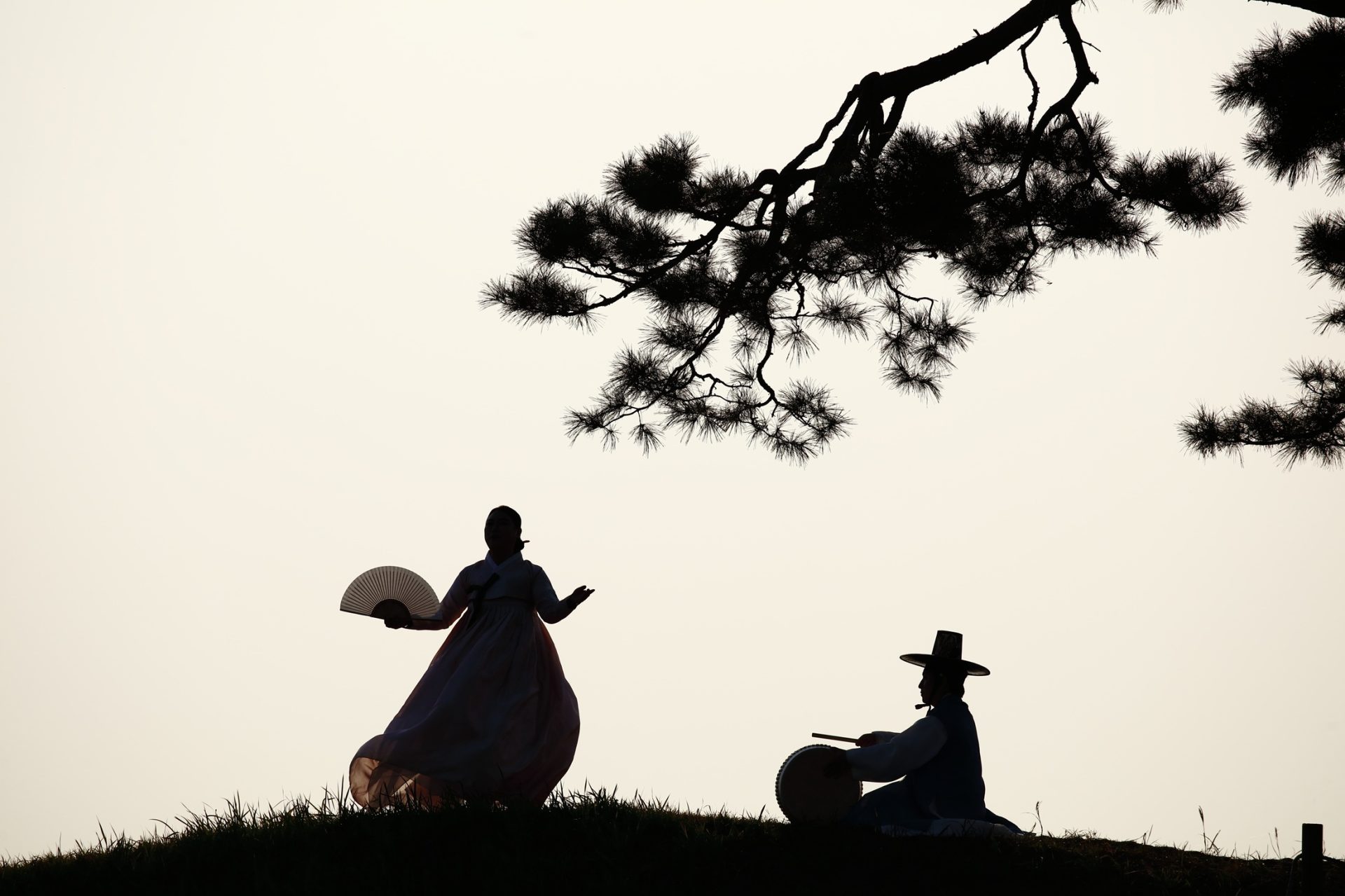
With no written score, no microphone, and nothing but a single drum and a human voice, Pansori paints entire universes. It is not merely music. It is a record of struggle, of singers who walked the equivalent of “20,000 Li” and spat blood along the way, and a vast epic shaped by Korea’s mountains, rivers, wind, and soil.
So today, we set off on a long journey, not with a camera, but with our ears. This is an expedition into a masterpiece recognized by UNESCO, and a living heritage rigorously safeguarded by the Korea Heritage Service as National Intangible Cultural Heritage No. 5.
THE HERITAGE From Dusty Grounds to UNESCO
1. Origins: The Sound of Clowns and of the Gods
When, and where, did Pansori begin?
Scholars generally place its emergence in the late 17th century, during the reigns of King Sukjong through King Yeongjo of the Joseon Dynasty. Yet its roots run far deeper, and academic discourse points to two primary theories regarding its origins
The Shaman Song Theory
According to this view, Pansori evolved from ritual chants sung by shamans during gut ceremonies in the Jeolla region. This helps explain the art form’s incantatory power, its ability to summon the divine, as well as its philosophical depth, which reflects on human fate and suffering.
The Clown Performers Theory
Another theory traces Pansori to itinerant entertainers, such as tightrope walkers and storytellers, who performed long narrative songs in marketplaces and in the courtyards of aristocratic homes. These performances fused song, speech, and gesture to captivate audiences from all walks of life
In its earliest form, Pansori was a form of street art, created to share in the joys and sorrows of ordinary people. Sung amid the dust of bustling markets, it gradually evolved in the 19th century into a refined art appreciated by the literati. Through scholars and reformers such as Shin Jae hyo, Pansori acquired a literary framework that systematized its narratives and aesthetics.
2. Inscribed as UNESCO Intangible Cultural Heritage (2003)
This raw and primal sound stunned the world on November 7, 2003, when UNESCO designated Pansori a “Masterpiece of the Oral and Intangible Heritage of Humanity.”
UNESCO highlighted two defining qualities: originality and improvisation.
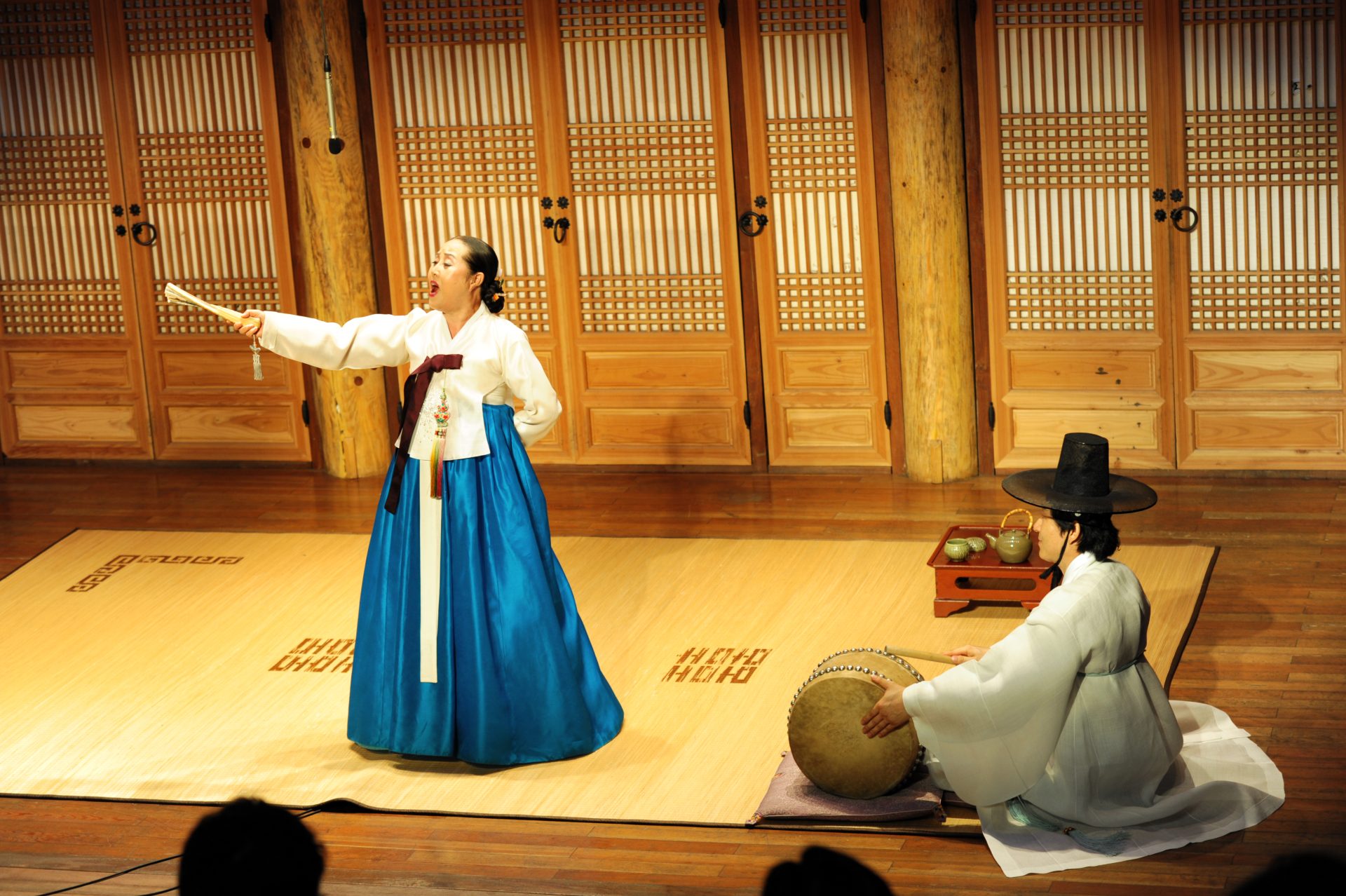
The format, often described as a “one person opera,” is unparalleled. A single singer embodies dozens of characters, shifting vocal color and timbre to bring each to life. Equally prized is the aesthetic of the pan, the performance arena, where, without a fixed score, each rendition is recreated anew through live interaction with the audience.
THE SYSTEM
How a Nation Protects Its Sound
Many international students react with disbelief when they first learn about Korea’s system of intangible cultural heritage.
“How can a country designate a person as a national treasure?”
To preserve the original form of Pansori, the Korea Heritage Service (formerly the Cultural Heritage Administration) operates an inheritance system so rigorous that earning recognition can be more difficult than obtaining a medical license or a doctoral degree.
How Pansori Became National Intangible Cultural Heritage No. 5
In 1964, the Korean government designated Pansori as National Intangible Cultural Heritage No. 5. With this decision, a sorikkun was no longer merely a performer, but a cultural asset, someone the nation itself is obligated to protect and sustain.
Becoming a “Human Cultural Treasure”: A Needle’s-Eye Process
The path to becoming a true master singer is nothing short of ascetic.
1. Initiation and Apprentice (Jeonsu-saeng)
Most aspirants seek out a master in their early teens, or even earlier. Training follows a strict master disciple model. There is no written score. Students learn solely through imitation, copying the shape of the master’s mouth and even the sound of their breathing. Only after years of such training can one be formally registered as an apprentice.
2. Certified Performer (Isuja, Completer)
To advance, a singer must be able to perform an entire madang, a full Pansori narrative, from beginning to end. Even the shortest takes around three hours, and the longest can exceed eight. Passing a stringent evaluation grants the title of Isuja. Reaching this stage typically requires 10 to 20 years of dedication.
3. Certified Instructor (Jeonseung Gyoyuksa)
Among certified performers, only those with exceptional skill and proven teaching ability are appointed as instructors. They are often referred to as “pre human cultural treasures.”
4. The Holder
At the summit stands the Holder. From among the instructors, only a handful, those who have devoted their entire lives to the art and attained mastery in both artistry and character, are granted the title of National Intangible Cultural Heritage Holder.
These individuals are revered as “Living Human Treasures.”
GEOGRAPHY (PART I) – Dongpyeonje (Eastern Style): Where Sound Is Forged Like Stone
Korea’s sound is divided by a river.
Running between Jeolla and Gyeongsang provinces, the Seomjin River marks the boundary between two great traditions: Dongpyeonje to the east and Seopyeonje to the west. This division is not merely geographical. The landscape itself, and the temperament shaped by it, are carved directly into the voice.
We begin east of the river, in a land ruled by the steep ridges of Jirisan.
The Aesthetic of Dongpyeonje: The Resonance of Stone
Dongpyeonje rejects excess.
Its sound is delivered plainly, thrown forward like a blow struck against rock. Phrases end abruptly, without lingering ornament, an approach known as daemadi daejang, in which musical lines are cut clean and decisive. The result is a style that is grand and forceful, masculine in energy, and never sentimental.
Namwon and Unbong: The Birthplace of the Eastern Voice
Any journey into Pansori begins in Namwon, the setting of Chunhyangga and the heart of Dongpyeonje.
Beyond the city, ascending toward Jirisan, lies Unbong, a highland plateau approximately 500 meters above sea level. Unbong is revered as the “Holy Land of Gugak.” It is the birthplace of Song Heung rok, often called the King of Singers and regarded as the founding figure of Dongpyeonje.
Legend holds that the winds of Unbong were so fierce that Song Heung rok trained before waterfalls, forcing his voice to overpower the roar of nature itself. He is said to have shouted until blood filled his throat. From this ordeal emerged tongseong, a full and penetrating vocal sound that came to define Dongpyeonje. The area’s villages and museums continue to bear witness to this brutal origin.
Gurye: An Untamed Voice
Following the Seomjin River southward brings you to Gurye, a region whose sound remains raw and unpolished, like stone drawn directly from the earth.
The master singer Song Mangap spent his later years here, carrying forward the orthodox Dongpyeonje lineage. Gurye’s sound is dense and physical, infused with the scent of soil and pine. Each year, the Dongpyeonje Sori Festival is held without amplification, allowing unmediated human voices to resonate across the foothills of Jirisan.
Sunchang: Discipline and Theory
Though globally known for fermented chili paste, Sunchang also played a critical role in shaping Dongpyeonje intellectually.
Here, the master singer Kim Sejong refined the raw power of the eastern style by incorporating classical Chinese poetry and literary references into Pansori lyrics. Through this process, Dongpyeonje gained structural clarity and scholarly dignity, making it accessible not only to common audiences but also to the aristocracy.
Gokseong: Solitary Training and the Tears of Simcheongga
The county of Gokseong is closely associated with the origin legends of Simcheongga. Its valleys and streams formed an ideal environment for dokkong, a form of solitary training in which singers withdrew completely from society.
Competing with the sound of waterfalls, generations of performers forged voices that were both clear and unyielding. The Dongpyeonje sound of Gokseong is marked by restraint, clarity, and inner tension.
Hamyang and Sancheong: The Borderland Voice
Although administratively part of Gyeongsang Province, Hamyang and Sancheong belong culturally to the Jirisan region and the Dongpyeonje tradition.
Here, the plaintive tonalities of Jeolla intersect with the blunt, grounded accents of Gyeongsang. The resulting sound is bold, direct, and uncompromising, among the most vigorous expressions in all of Korean Pansori.
Dongpyeonje in One Line
If Seopyeonje sings sorrow into bloom, Dongpyeonje hammers sound into form.
GEOGRAPHY (PART II) – Seopyeonje (Western Style): Where Sorrow Comes into Bloom
Crossing the Seomjin River to the west, the scenery shifts. Sharp mountain ridges recede, replaced by the wide Naju Plain, red clay soil, and the endless horizons of the Yellow Sea and the South Sea.
The sound of this land, Seopyeonje, is sorrowful. Or rather, it transforms sorrow into art. Notes are drawn out, their endings extended to leave lingering resonance. Ornamental inflections, known as sigimsae, melt the listener’s heart. This is the distilled essence of the Korean emotion known as han.
Gwangju: The Crucible of Modern Sound
Gwangju is the artistic capital of the south and the primary hub through which Seopyeonje spread.
The Legend of Im Bang ul
During the Japanese colonial period, the legendary master singer Im Bang ul performed here, soothing the anguish of a nation that had lost its sovereignty. His signature piece, Ssukdaemeori, reportedly sold over one million records, an astonishing figure for its time.
A Living Scene
Gwangju does not preserve tradition behind glass. It consumes and regenerates it. Through competitions such as the Im Bang ul Gugak Festival, the city continues to produce new star singers. Even today, Pansori drifts from taxi radios, woven into daily life.
Boseong: Refined Sound, Perfected
Surrounded by the scent of green tea fields, Boseong is home to what is often considered the most refined form of Seopyeonje. The region established its own distinctive identity known as Boseong sori.
Jeong Eung min, Master Singer
Living in seclusion in Yeongcheon Village, Jeong Eung min fused the powerful projection of Dongpyeonje with the intricate ornamentation of Seopyeonje. National treasure level singers such as Cho Sang hyeon and Seong Chang sun all passed through this lineage.
Character
Boseong’s sound never wallows. It is sorrowful without being servile, ornate without excess. The dignity of the scholar gentry lingers in its tone.
Naju: A River of Elegance
The city of Naju, where the Yeongsan River winds through fertile plains, served as an administrative center of Jeolla Province during the Joseon Dynasty.
The Legacy of Park Yu jeon
Regarded as the founder of Seopyeonje, Park Yu jeon’s sound took root here. Naju’s Pansori reflects the composure of abundant plains and the unhurried flow of the river, measured, elegant, and expansive.
“Mokpo is a port.”
Within that simple statement lies a city shaped by meetings and partings, laughter and tears.
Sound and the Public
In the modern era, Mokpo became a center of theater culture where master singers performed directly for popular audiences. Figures such as Kim Chang hwan and Oh Jeong suk passed through its stages. Sung against sea winds, Mokpo’s Pansori carries a briny pathos, heavy with departure.
Haenam and Gangjin: Sorrow at the Edge of the Land
At the southernmost tip of the peninsula lie Haenam, home to the village known as Ttangkkeut, and Gangjin, where the scholar Jeong Yak yong once lived in exile.
A Sound of Depth
Here, the voice grows dark and ocean deep. Influenced by shamanic music such as the Jindo ssitkimgut, Seopyeonje acquires a ritual intensity. The loneliness of exiles and the warmth of southern communities intertwine, producing a uniquely tragic beauty.
Gochang: The Academy of Pansori
On the west coast of North Jeolla Province, Gochang occupies a singular position. Geographically eastern yet culturally fused, it is where traditions converge.
Shin Jae hyo and Jin Chae seon
The theorist and patron Shin Jae hyo systematized orally transmitted lyrics here, transforming Pansori into a coherent art form. He also trained Jin Chae seon, the first female master singer, breaking a long standing gender barrier. Gochang stands as Pansori’s great library, where Dongpyeonje and Seopyeonje were organized into theory.
Damyang and Hwasun: Songs of Bamboo
The bamboo forests of Damyang and the inland valleys of Hwasun still echo with the breath of Seopyeonje masters.
Character
The rustle of bamboo leaves and the calls of mountain birds seep directly into the melodic lines. Based in Damyang, the master singer Park Dong sil even composed yeolsa ga, patriotic Pansori works that stirred anti colonial sentiment.
Seopyeonje in One Line
If Dongpyeonje strikes sound like stone, Seopyeonje lets sorrow blossom into voice.
THE THEORY – Gobeop and the Universe of Seven Rhythms
Pansori is not built on voice alone. It is completed only when singing is joined by gobeop, the art of drumming, and Jangdan, its rhythmic cycles. A well-known saying captures this hierarchy: “First the drummer, second the singer.” The drum does not merely accompany the voice; it leads it.
Among foreign students studying Pansori, nothing inspires more awe than its seven core rhythmic patterns. Below, each is examined in depth, alongside representative lyrics.
1. Jinyangjo: The Aesthetics of Slowness (24 Beats)
Tempo: Very slow (30–40 BPM)
Mood: Grandeur, profound sorrow, vast nature
Analysis
Jinyangjo is the slowest rhythm in Pansori. It consists of twenty-four beats, structured as four six-beat phases traditionally described as gi, gyeong, gyeol, and hae. Within this extended breath, the singer gathers emotion from the deepest reserves, stretching time to its very limit.
Lyrics Focus
Simcheongga, “Beompi Jungnyu,” the moment Simcheong boards a boat and drifts toward the sea to sacrifice herself.
Lyrics (Translation)
“Floating in the middle of the river, the boat drifts on.
The vast blue sea spreads endlessly, its waves surging wide.”
Explanation
The slow pulse of jinyangjo mirrors the infinite horizon of the ocean and Simcheong’s despair before death, unfolding like a cinematic long take.
2. Jungmori: A Twelve Beat Walk
Tempo: Moderate (80–90 BPM)
Mood: Stability, narration, restraint
Analysis
Jungmori closely resembles the pace of ordinary walking and the rhythm of the human heartbeat. It is most commonly used for storytelling and lyrical description.
Lyrics Focus
Chunhyangga, “Ssukdaemeori,” Chunhyang, imprisoned and disheveled, longing for her lover.
Lyrics (Translation)
“With hair disheveled like mugwort, looking like a ghost,
in this cold, silent prison cell, all I can think of is my love.”
Explanation
One of the most beloved passages in Pansori, its understated rhythm intensifies sorrow through calm restraint.
3. Jungjungmori: Twelve Beats That Dance
Tempo: Moderately fast (90–110 BPM)
Mood: Joy, motion, exuberance
Analysis
Built on a triple subdivision twelve-beat structure, jungjungmori is instantly buoyant and physical. While often used for festive scenes, it can also paradoxically convey emotional frenzy at moments of extreme grief.
Lyrics Focus
Heungboga, “Hwacho jang Taryeong,” Nolbu proudly carries home a luxurious cabinet.
Lyrics (Translation)
“Hwachojang, hwachojang, I got myself a hwachojang.
I got it, I got it, I finally got one.”
Explanation
Nolbu’s greedy yet comical swagger is vividly animated through the bouncing rhythm.
4. Jajinmori: The Chase
Tempo: Fast (120–140 BPM)
Mood: Tension, urgency, pursuit
Analysis
Jajinmori drives relentlessly forward. It is used to list events in rapid succession or to depict chases. Many passages are delivered in breathless torrents, often compared to rap for their density and speed.
5. Hwimori: Into the Storm
Tempo: Very fast (180 BPM and above)
Mood: Climax, panic, extremity
Analysis
The fastest rhythm in Pansori, hwimori surges so quickly that it can feel like a two-beat or four-beat cycle. It is reserved for climactic moments.
Lyrics Focus
Simcheongga, “Sim Bongsa Falls into the Water”
Explanation
As Sim Bongsa flails helplessly in the water, his frantic movements are amplified by the driving speed of hwimori, heightening dramatic tension to its peak.
6. Eotmori: The Mystery of Ten Beats
Tempo: Irregular (10/8 pattern: 3–2–3–2)
Mood: Strangeness, mysticism, unreality
Analysis
Eotmori is the rhythm foreign audiences often find most fascinating. Its uneven beat pattern creates a limping, uncanny sensation. It is typically used when non-human figures, tigers, monks, hermits, or spirits, enter the scene.
Lyrics Focus
Sugungga, “Beom Naeryeonda,” the tiger descends from the forest.
Lyrics (Translation)
“The tiger is coming down.
From the deep pine forest, a beast descends.”
Explanation
Later reimagined by the band Leenalchi to global acclaim, this passage demonstrates how eotmori’s irregular rhythm sonically embodies the tiger’s ominous, distorted movement.
7. Aniri: The Art of Speech
Definition
Spoken narration without rhythmic accompaniment.
Function
Comparable to stand-up comedy, aniri allows the singer to provoke laughter, explain the plot, and regain breath. Mastery of aniri is essential to true artistry. It functions as both pause and adhesive, binding the narrative together and controlling its flow.
THE LEGENDS – The Singers Who Became Myth
Pansori has no written score. It is transmitted mouth to mouth, heart to heart. Its history, therefore, is a history of people. Many master singers have risen and faded, but in the modern era of Pansori, two towering figures stand beyond omission.
One is Park Dong jin, the indongcho who pierced solid rock.
The other is Ahn Sook sun, the crane who took flight above the clouds.
1. Indongcho (忍冬草), Park Dong jin: The Man in the Guinness Book
(1916–2003)
Park Dong jin’s life reads like a martial arts epic, an odyssey of endurance and human triumph. He is remembered by the public for phrases that became cultural catchwords, yet behind them lay years of suffering beyond imagination.
The Hardship
“If it was for sound, I even drank filth.”
In his youth, Park faced a trial tantamount to a death sentence for a singer. After abusing his voice, his vocal cords failed him, and no sound would come out. He retreated to a mountain hermitage in Gongju, South Chungcheong Province, and undertook one hundred days of solitary training.
He shouted day and night in deep isolation. His throat swelled, split, and bled. Still, he did not stop.
When the swelling would not subside and fever raged, he resorted to folk remedies. He drank a liquid filtered from human waste, believed at the time to purge toxic heat. Modern medicine offers no explanation, but Park’s obsession with sound transformed even this ordeal into fuel. From it emerged a voice as hard and resonant as iron, his famed “Iron Voice.”
The Record
An Eight Hour Battle That Stunned the World
By the 1960s, Pansori faced a crisis. Long narratives were abandoned in favor of short, popular excerpts, eroding its epic structure. Park rebelled.
In 1968, he completed a five-hour full performance of Heungboga, shocking the Pansori world. In 1969, he went further, performing Chunhyangga in its entirety, nonstop, for eight hours.
Imagine it: standing alone for eight hours, singing, dancing, laughing, crying, and embodying dozens of characters, with only brief moments to sip water. Even leading opera singers collapse after two hours.
The achievement was recorded in the Guinness Book of Records as the longest solo performance in the world. Park went on to complete all five major Pansori epics, restoring a lineage that had nearly been severed. Today’s singers pursue wan chang, the full performance, because Park proved it was still possible.
The Innovation Jesus Pansori and Popularization
Park did not confine himself to tradition. A devout Christian, he premiered Jesus jeon in the early 1970s, a newly composed Pansori based on the Bible.
To chant scripture in Pansori style, “And God said…,” was radical. Yet Jesus jeon demonstrated that Pansori could carry not only Korean folklore, but universal human narratives. It became a crucial gateway through which foreign missionaries and believers encountered the art form.
2. The Eternal Prima Donna, Ahn Sook sun: A Heavenly Voice
(Born 1949)
If Park Dong jin was rock forced through soil, Ahn Sook sun is a gem refined to brilliance, a crane in flight. She is the most widely recognized singer of her generation, rightly known as the prima donna of Korean traditional music.
The Prodigy
A Genius Born in Namwon
Born in Namwon, she began training at the age of nine. She studied under her aunt Kang Sun young, a master of gayageum accompaniment, and later under legendary figures such as Kim So hee and Park Gwi hui.
In Korean traditional music, a naturally pure voice is called cheonguseong, a heavenly timbre. Ahn possesses it. Her voice is high and clear, yet grounded in deep diaphragmatic resonance. Even in her seventies, her upper register remains unwavering.
The Master Pansori and Instrumental Song
Unusually, Ahn reached the summit in two fields.
In Pansori, she is recognized as the holder of Chunhyangga under National Intangible Cultural Heritage No. 5, exemplifying the restraint and elegance of the Gangsan style. She was also designated a holder of gayageum byeongchang under National Intangible Cultural Heritage No. 23, mastering a form that unites singing, instrumental performance, and dramatic expression.
The Ambassador
On the World Stage
Ahn served as artistic director of the National Changgeuk Company and as an ambassador for the Yeosu Expo. From the Avignon Festival in 1998 to Lincoln Center and Carnegie Hall, she introduced Korean sound to the world. Foreign critics praised her as “the Maria Callas of the East” and “a small giant who moves the soul.”
3. Other Voices That Defined an Era
Beyond Park and Ahn, other legends shaped Pansori’s modern history.
Im Bang ul
The king of Seopyeonje, he was an idol of the 1930s. His recording of Ssukdaemeori sold over one million copies, channeling national grief through sorrowful modes during the colonial era.
Kim So hee
Known as the mother of Pansori, she founded the ManJeong style and elevated the status of female singers. A polymath of calligraphy, dance, and song, she introduced Pansori to the world at the 1972 Munich Olympics. Many of today’s masters are her disciples.
Interview Imagination
A Fictional Dialogue
Q. What is Deugeum, sound enlightenment?
Park Dong jin:
“It means walking toward death. Entering the mountains, staking your life, and fighting nature. Spitting blood, drinking filth, turning your body into an instrument. Without that, you cannot move another person’s heart.”
Ahn Sook sun:
“It is emptying the self. Not singing with technique, but shedding desire and becoming Chunhyang, becoming Simcheong, speaking with their hearts. That, I believe, is Deugeum.”
LIVING TREASURES – The Active Human Cultural Treasures, 2025
Just as one visits a museum to see Goryeo celadon, Korea is also home to national treasures that walk, breathe, and perform. These are the officially recognized holders of Pansori and gobeop, designated through rigorous evaluation by the Korea Heritage Service.
(As of 2025)
They are living time capsules, bodies that preserve centuries-old sound in its original form. When traveling in Korea, do not overlook posters bearing their names.
VOCAL – Guardians of the Voice
1. Shin Young hee – Chunhyangga
Style: A direct disciple of Kim So hee. Her voice is rough and husky, yet within that grain lies the full spectrum of human emotion.
Point: Equally powerful in sorrow and comedy, she commands the audience with unmatched charisma.
2. Kim Yeong ja – Simcheongga
Style: Holder of the Gangsan style Simcheongga, blending Seopyeonje’s poignancy with Dongpyeonje’s grandeur.
Point: Rose from provincial designation to national recognition. Her tone is clear, yet firmly grounded.
3. Jeong Hoe seok – Simcheongga
Style: The orthodox lineage of Boseong sori, from grandfather Jeong Eung min to father Jeong Gwon jin, a true “Pansori royal family.”
Point: Restrained, scholarly, and precise, a model of dignified sound.
4. Kim Su yeon – Sugungga
Style: Richly infused with the thick flavor of southern folk song.
Point: A robust, energetic delivery that captures the humor and vitality of Sugungga.
5. Kim Il gu – Jeokbyeokga
Style: Both a master singer and a virtuoso of ajaeng sanjo, crossing instrumental and vocal domains with ease.
Point: Expresses the epic tragedy of Jeokbyeokga, the most demanding of the five cycles, with battlefield-like force.
6. Yun Jin cheol – Jeokbyeokga
Style: A leading Boseong sori master from Gwangju.
Point: Communicates with younger audiences through modern sensibility and lucid interpretation, maintaining clarity even at rapid tempos.
7. Lee Nan cho – Heungboga
Style: A steadfast keeper of Namwon’s Dongpyeonje lineage and a disciple of Kang Do geun.
Point: Exemplifies daemadi daejang, bold, chopped phrasing with a thick, powerful tone, unadorned and quintessentially Pansori.
DRUM – Masters of Gobeop
1. Kim Cheong man
Title: Holder of Gobeop
Reputation: It is said that “a singer cannot sing without Kim Cheong man’s drum.” He reads a singer’s breath instinctively. His drumming does not merely accompany the voice; it dances with it.
2. Park Si yang
Title: Holder of Gobeop
Reputation: Active in Gurye and other Dongpyeonje strongholds, he anchors Pansori with drumming that is raw, forceful, and structural, laying the very backbone of the art.
APPENDIX A
PANSORI GLOSSARY: Essential Terms for International Audiences
Key terms for fully experiencing a Pansori performance.
1. Sorikkun – The Singer
The vocalist who performs Pansori. Rather than using the general word “singer,” the suffix -kkun (meaning professional or craftsman) is added to emphasize craftsmanship and mastery.
2. Gosu – The Drummer
The performer who plays the barrel drum (buk). More than an accompanist, the gosu is the singer’s partner and conductor. A well-known saying captures this relationship:
“First the drummer, second the singer.”
3. Chuimsae – The Cheer
Short exclamations voiced by the drummer or the audience during a performance, such as “Eul ssu,” “Jota,” or “Jalhanda.”
These are not interruptions or noise. They are essential injections of energy that drive the singer forward and shape the live performance.
4. Ballim / Neoreumsae – The Gesture
The physical acting performed by the singer, often using a folding fan. With a single prop, the fan becomes a mountain when opened, a conductor’s baton when closed, or a bundle of belongings when placed on the head.
5. Deugeum – Sound Enlightenment
The state reached after years of extreme training, when the voice fully opens and responds freely to the singer’s intent. Achieving Deugeum is the ultimate goal of every Pansori performer.
6. Doseop – Free Rhythm
An advanced technique in which the singer stretches and compresses rhythm beyond fixed jangdan patterns, performing with spontaneous timing. It is often compared to jazz scat singing for its improvisational nature.
APPENDIX B
TRAVEL GUIDE: Following the Sound
1. Namwon Chunhyang Festival
When: Every May
Where: Gwanghallu Pavilion area, Namwon, North Jeolla Province
What: Korea’s most iconic Pansori festival. Alongside the Chunhyang beauty pageant, leading master singers perform against the illuminated nightscape of Gwanghallu, transforming legend into living sound.
2. Jeonju International Sori Festival
When: September–October
Where: Sori Arts Center of Jeollabuk do, Jeonju
What: A fusion festival where Pansori meets world music. It offers a front row view of how traditional sound continues to evolve in contemporary forms.
3. Gurye Dongpyeonje Sori Festival
When: October
Where: Seosicheon Sports Park, Gurye
What: No microphones. The wind from Jirisan competes with the unamplified human voice. This is Pansori in its rawest, most elemental state, an outdoor festival where nature itself becomes part of the performance.
4. National Gugak Center
Locations:
Seoul (Seocho), Namwon (Folk Music Center), Jindo (Namdo Center), Busan
Tip: Regular Saturday performances are held year round. With good timing, one may witness performances by Human Cultural Treasures for as little as 10,000 to 20,000 KRW, and occasionally for free.
EPILOGUE: The Journey That Never Ends
We have walked a twenty thousand li road of sound, from the dust filled markets of Namwon, past the waterfalls of Unbong where singers once spat blood, all the way to Paris, home of UNESCO’s headquarters. Through it all, Pansori has never stopped moving.
If you have read this long piece without a single photograph, here is a final suggestion. Close the book. Take out your earphones. Go south, into Korea. Close your eyes. The crimson voice that has resonated across this land for centuries will begin to beat against your heart.
Eul-ssu!