In the spring of 2026, we are not taking you to Seoul, with its glowing neon lights and restless pace. Instead, we invite you south—toward a quieter beginning, to the clear and gentle waters of the Seomjin River.
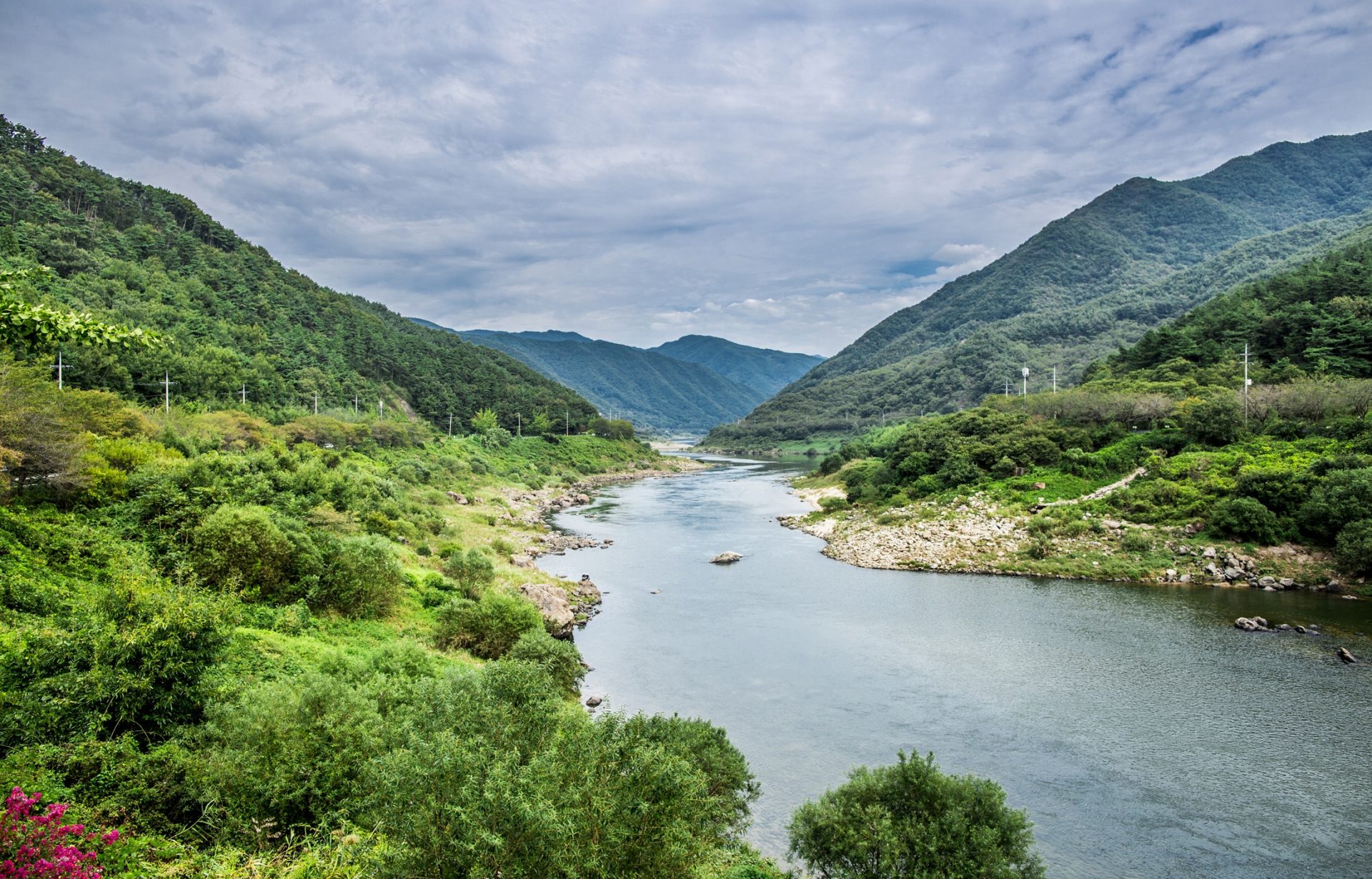
Korea is home to many rivers, but ask locals which is the most beautiful, and nine out of ten will answer without hesitation: the Seomjin. Flowing between the majestic ridges of Jirisan and the soft blue breath of the southern sea, this river is known for having some of the cleanest waters in the country—a living artery of the land.
Yet the Seomjin River reveals its true magic in one season above all others: spring.
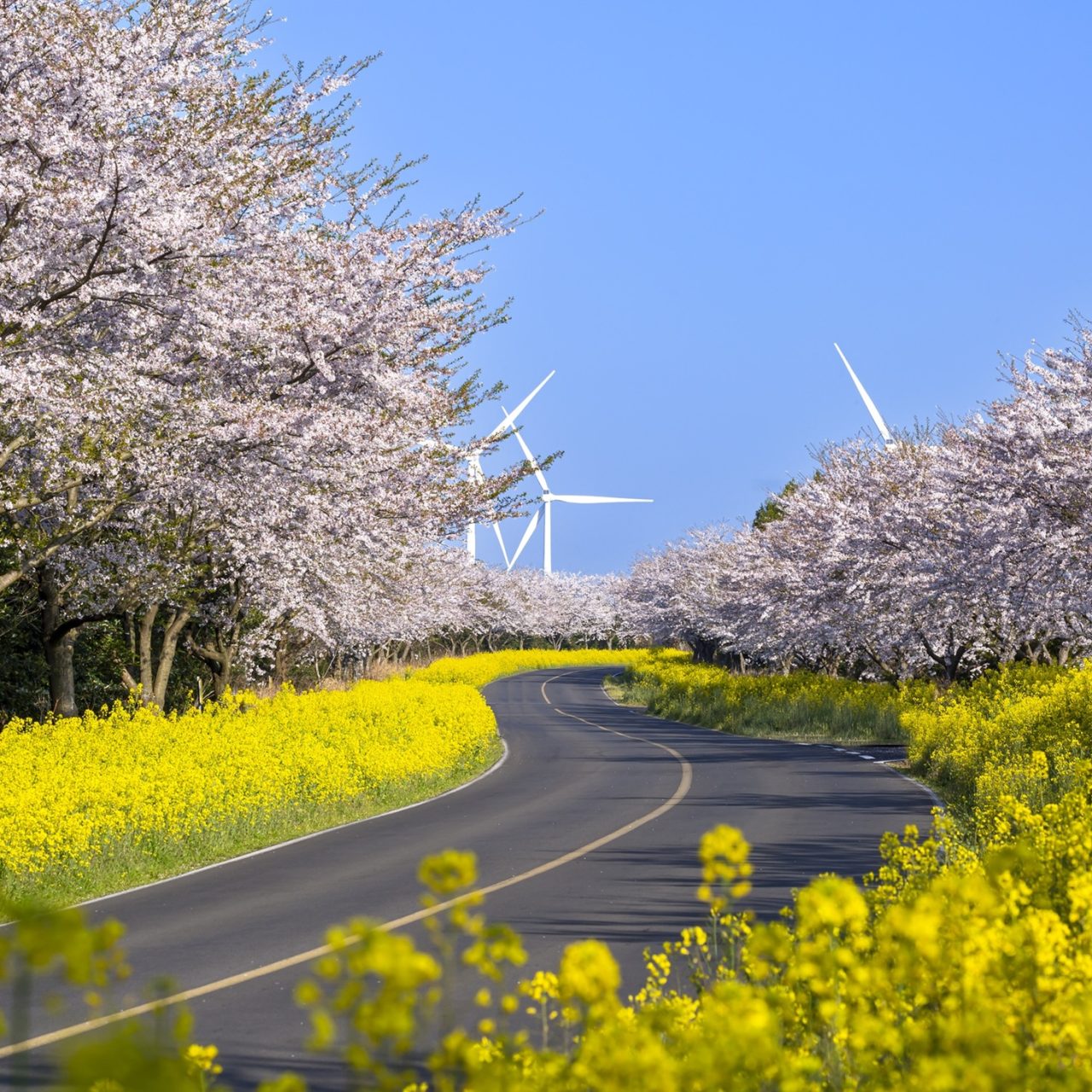
Carried by warm winds rising from the southern coast, spring travels upstream along the river’s course. Wherever that breeze arrives, flowers follow—village by village, bend by bend. Along its banks, the landscape awakens in sequence, as if guided by an unseen hand.
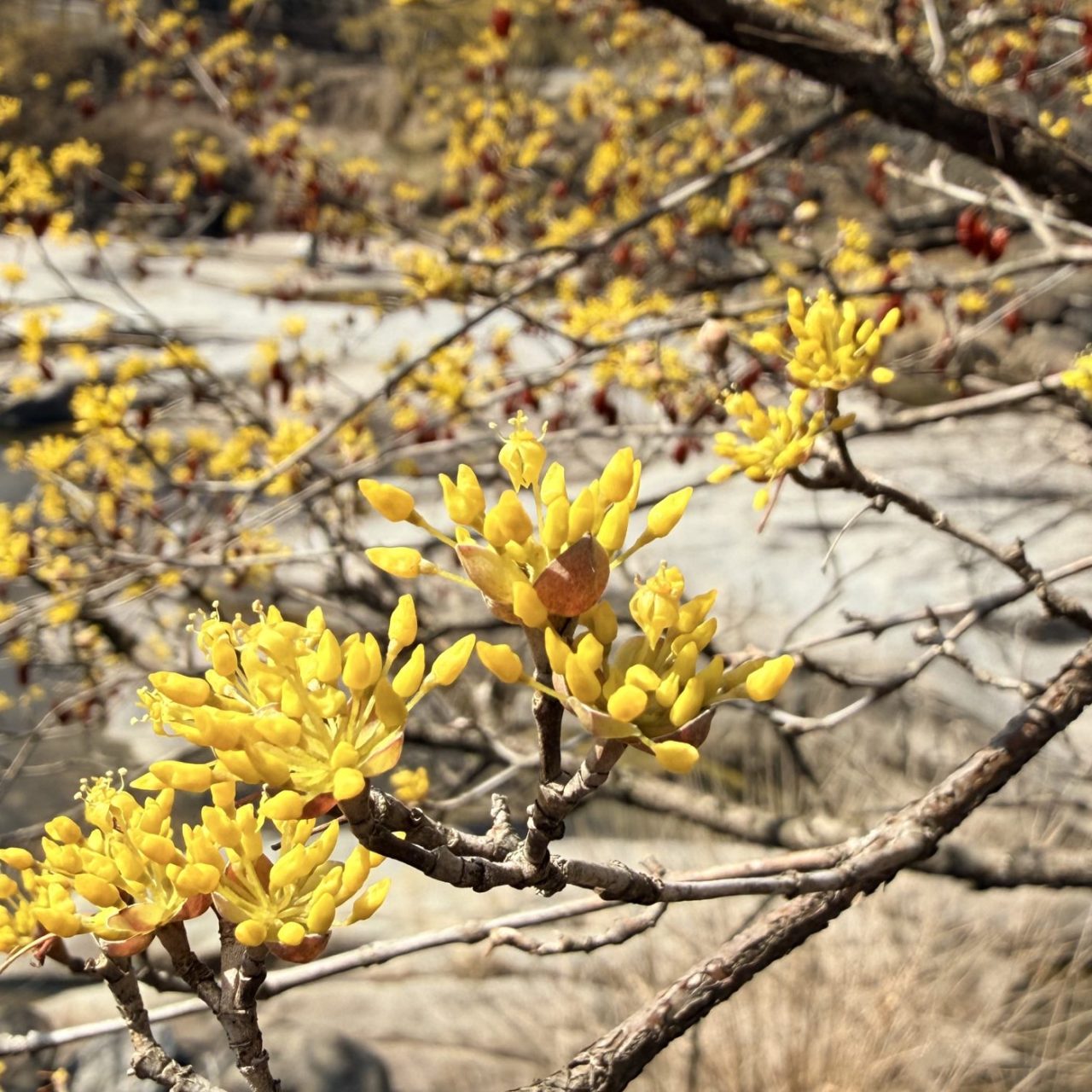
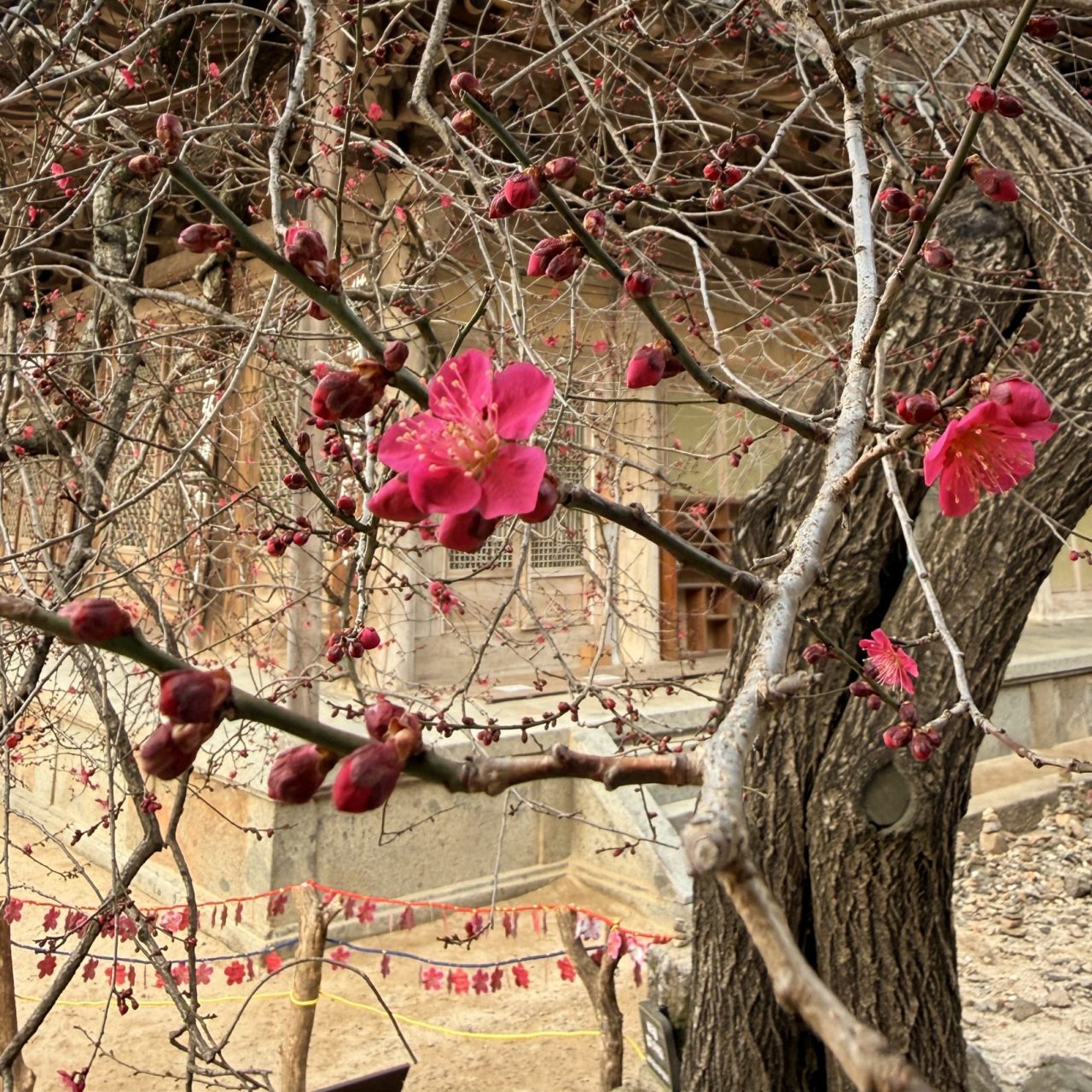
In Gwangyang and Gurye, white plum blossoms and golden cornelian cherries appear first. Farther north, in Hadong, soft pink cherry blossoms take their turn. It feels as though the river itself has become a brush, painting color onto what was once a muted, winter-worn canvas.
This is why Koreans often call the Seomjin the River of Flowers.
The journey that follows traces this river’s path—traveling alongside the current, into the places where spring quietly announces its arrival. Follow the scent of damp earth and blossoms carried on the wind. Listen to water moving steadily, without urgency.
This is where spring begins in Korea. And this is where our journey begins, too.
The White Utopia: Gwangyang Maehwa Village
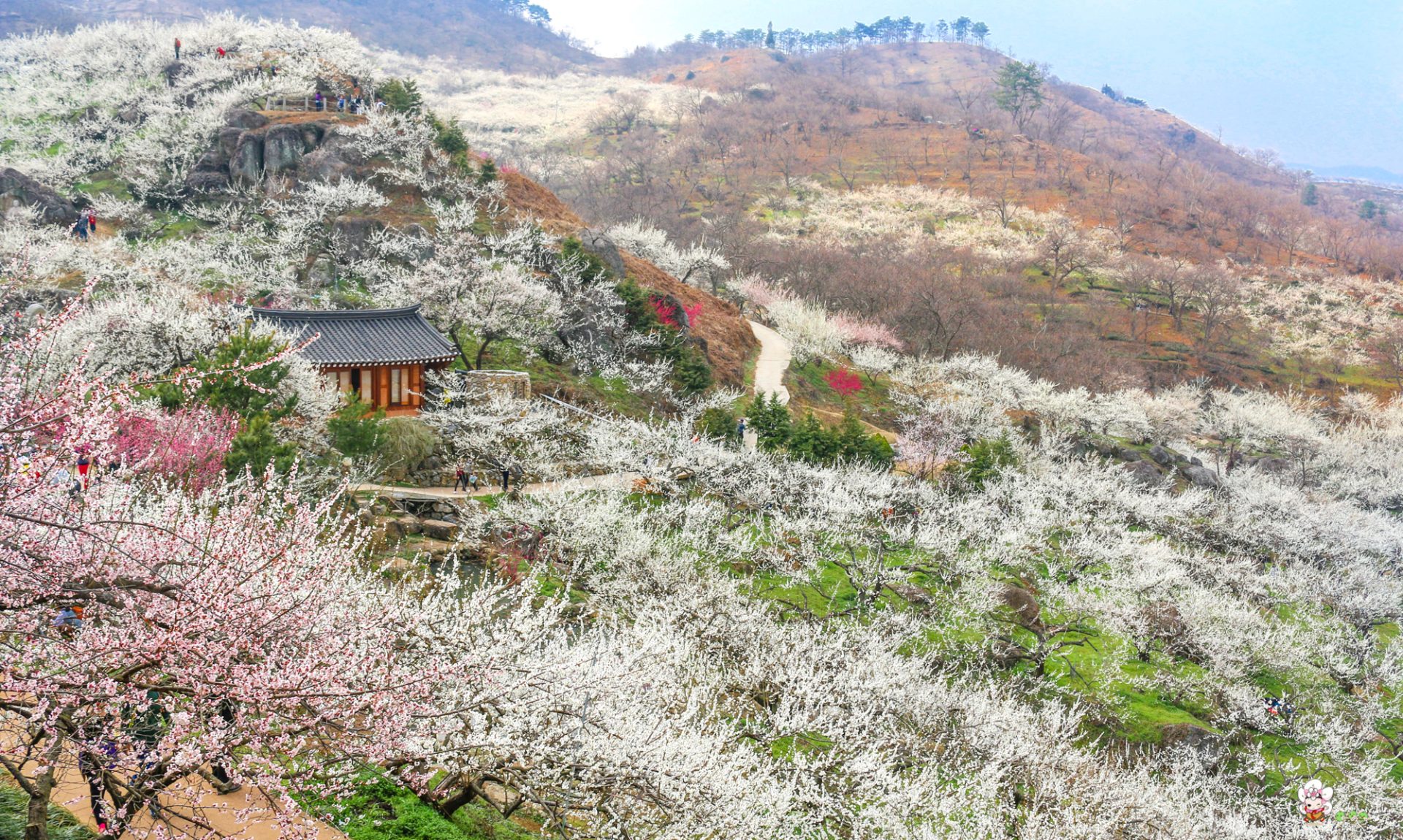
Spring in Korea opens its eyes first in the far south, on a quiet mountainside where river and sea converge along the Seomjin River. While Seoul is still wrapped in thick coats, reluctant to let winter go, Gwangyang Maehwa Village has already transformed into a world so white it feels almost unreal.
“Is it snow—or clouds?”
That is the first question many international visitors ask upon arrival.
Here, on the steep slopes of Baekunsan (1,222 meters above sea level), the land descends toward the blue curves of the river. On this incline, more than 100,000 plum trees have taken root, cascading down the hillside like a frozen wave in motion.
Spring in 2026 is expected to arrive slightly earlier than usual. According to seasonal forecasts, the first plum buds may begin to open around February 20, with full bloom anticipated between March 8 and March 15. At its peak, the village appears as if dusted with fresh snow—or as though a massive white cloud has drifted down and paused on the mountainside. Step closer, and you realize it is neither snow nor cloud, but living blossoms, breathing out a sweet, intoxicating fragrance.
This is no accidental landscape. What was once barren chestnut land was transformed over more than half a century by one woman, Hong Ssang-ri, who married into the village and patiently turned stone-filled soil into a vast work of land art. She cleared rocks by hand, planted plum trees one by one, and waited. Those trees became a forest. Today, more than one million visitors come each spring to witness what many call a miracle.
Black tiled roofs dusted with white petals. Thousands of traditional earthenware jars clustered together. A river flowing as clear as glass. This is not the geometric, ornamental beauty of Western gardens. It is something distinctly Korean—an aesthetic that honors natural curves, embraces empty space, and balances line and color with quiet restraint.
If you wish to see something that feels like heaven on earth—or to encounter Korea at its most poetic—this is where you should be.
Scene: What You Will See
Arriving at Gwangyang Maehwa Village, you may find yourself holding your breath before pressing the shutter. The scale is overwhelming; the beauty, precise.
(1) The Harmony of Jars and Blossoms
This is the image that draws photographers across oceans. In the courtyard of Cheong Maesil Farm, more than 2,000 traditional earthenware jars (jangdok) stand in disciplined rows. Inside them, plum syrup and soybean paste have been fermenting for decades—some for over 50 years.
The View:
When morning light falls at an angle, the dark brown jars glow gold. Above them, white plum petals burst like popcorn and drift down, settling gently on the lids. Behind it all, the Seomjin River traces a soft S-shaped line through the landscape.
Brown of earth. White of flowers. Blue of water.
It is one of the most classical and elegant color compositions you will encounter in Korea.
(2) Bamboo Forest & Flower Rain
Follow the walking path behind the farm, and you’ll discover a hidden bamboo grove. Tall green stalks rise straight toward the sky, contrasting beautifully with the soft curves of the plum trees.
A Sensory Moment:
Close your eyes. Hear bamboo leaves brushing against one another in the river breeze. Smell the deep sweetness of plum blossoms carried on the air. This is a forest that heals not only through sight, but through sound and scent.
(3) Hanok & Scenes from Film
This village has served as the backdrop for countless films and dramas, including Chihwaseon by master director, Im Kwon-taek. Midway along the trail, pause at the thatched-roof house set. Sit on the wooden porch and look out toward the river framed by plum branches.
For a moment, it’s easy to imagine yourself as a Joseon-era scholar—watching time pass slowly, deliberately.
(4) The Best Viewpoint
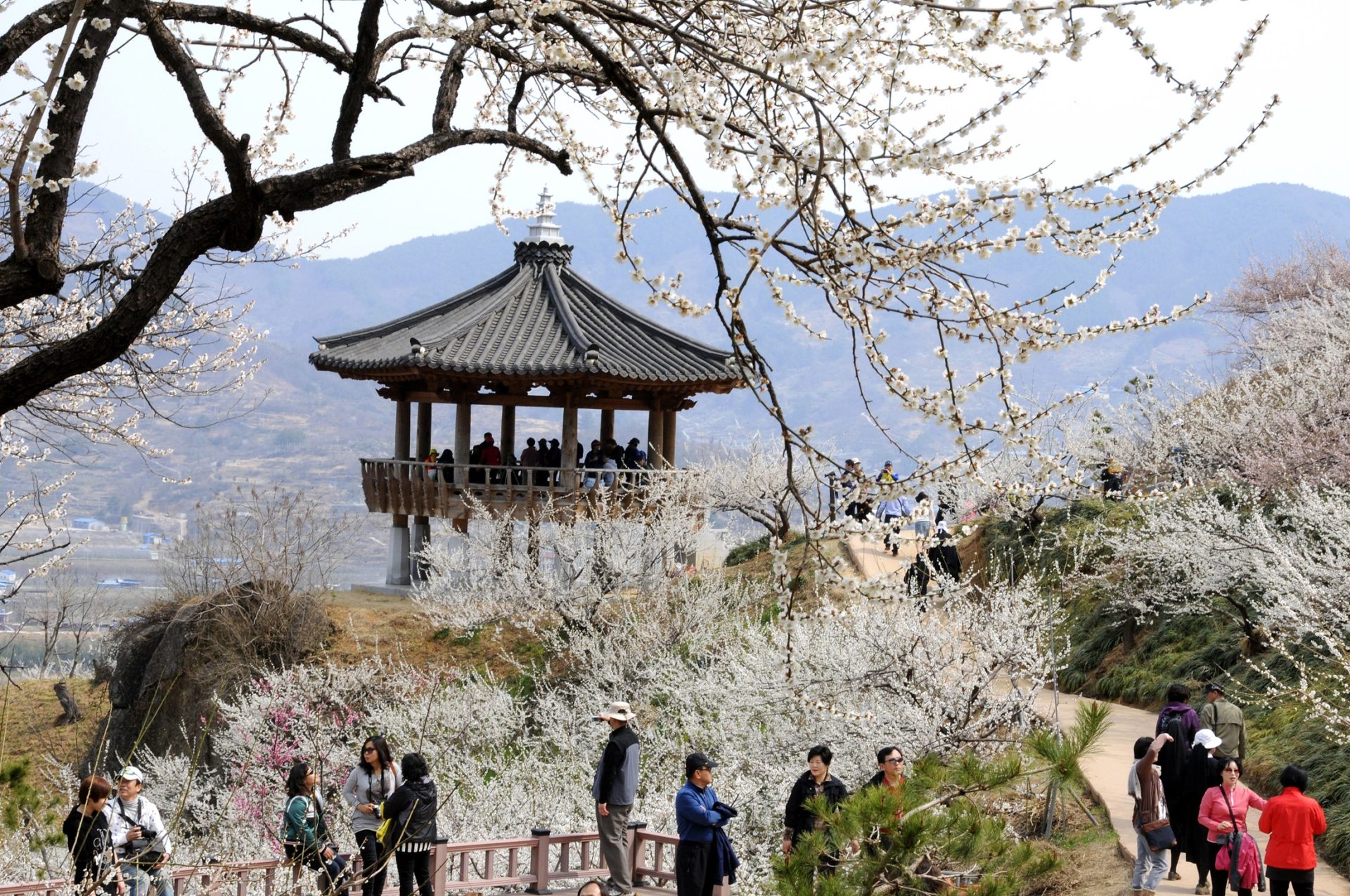
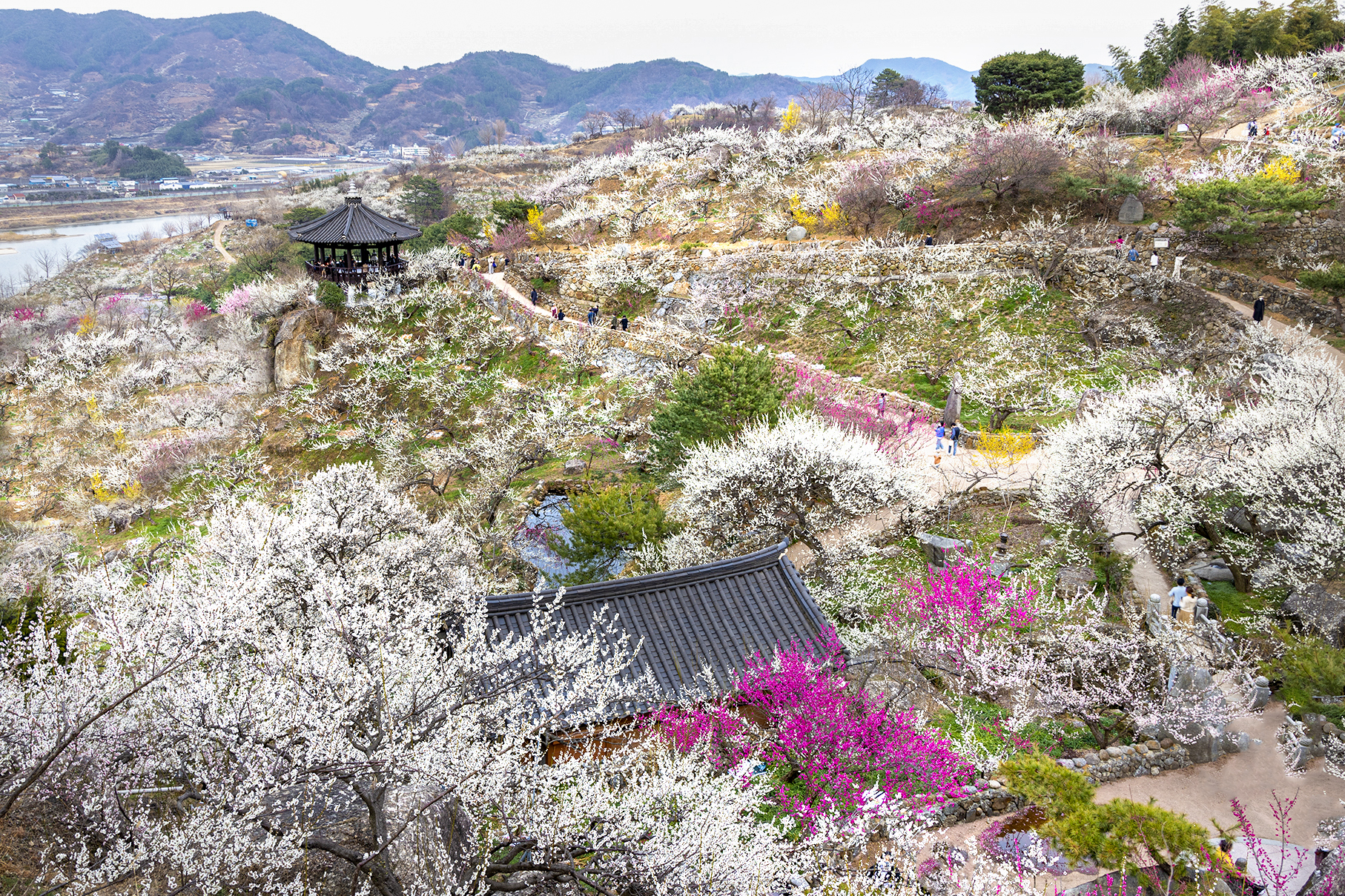
Even if you’re slightly out of breath, climb to the highest pavilion. Below you, white plum clouds ripple across the mountainside. In the distance, the Seomjin River flows calmly, with the hills of Hadong rising beyond.
Seen from here, the village truly resembles Mureungdowon—the mythical utopia of East Asian legend.
Taste: Eating the First Days of Spring
After seeing spring unfold across the hillsides, it’s time to taste it.
In Korea, there is an old saying: “Geumgangsan is beautiful—but eating comes first.” No matter how breathtaking the scenery, a journey is only complete when it reaches the table.
Along the Seomjin River, spring arrives not only in blossoms, but in flavor—bright, clean, and deeply rooted in the land.
(1) Dining Under the Blossoms:
Cheong Maesil Farm Cafeteria
You don’t need to leave the village to enjoy its most iconic flavors. At the highest point of Cheong Maesil Farm, beside rows of centuries-old earthenware jars, an open-air cafeteria awaits. Calling it a “restaurant” feels inadequate—it is closer to a viewing platform where food and landscape merge into a single experience.
Wooden tables are set beneath blooming plum trees. From here, you look down over the white hills of blossoms, the river glinting quietly in the distance. Plates arrive warm, simple, and deeply satisfying.
What to Order
- Plum Makgeolli (Maesil Makgeolli)
Brewed with locally grown plums, this lightly sparkling rice wine is fragrant and unexpectedly elegant. Its gentle sweetness balances the natural acidity of the fruit, making it closer to champagne than to the heavy rice wines some travelers expect. - Pajeon (Scallion Pancake)
Often described as Korea’s answer to pizza, pajeon is crisp on the outside and soft within, generously filled with scallions and seafood. Paired with makgeolli, it becomes the quintessential spring combination—savory, comforting, and celebratory. - Plum Ice Cream
The perfect finale. Refreshing, lightly tart, and unmistakably seasonal. At around KRW 4,500, it’s one of the most memorable desserts you’ll find on this journey.
Why It Matters
Eating here is not about fine dining. It’s about context—food that tastes better because of where you are, the air you’re breathing, and the blossoms falling quietly around you.
Practical Info
- Location: Within Gwangyang Maehwa Village, next to the jar courtyard
- Operating Season: Spring (March), especially during festival dates
(2) The Soul Soup of the River: Dongheung Sikdang (Jaecheop-guk)
After leaving the plum village, cross the river into Hadong town. This is where locals insist you stop—and where travelers come to understand the Seomjin River through taste.
Dongheung Sikdang has specialized in jaecheop-guk, a clear soup made from tiny freshwater clams harvested from the Seomjin River, for more than 60 years. For the people of Hadong, this dish is not a seasonal novelty—it is daily life.
The Dish: Jaecheop-guk Set
The soup arrives crystal clear, lightly tinted by the clams themselves. There are no heavy seasonings. The flavor comes purely from the river—clean, mineral, and quietly deep. The clams are small but abundant, releasing their essence slowly into the broth.
Served alongside are more than ten traditional Korean side dishes, changing with the seasons. Together, they form a meal that feels restorative rather than indulgent.
One spoonful in, and you understand why locals say this soup “clears the body.”
Where the plum village shows spring as spectacle, jaecheop-guk expresses it through restraint. This is food that exists only because the river remains clean enough to sustain life—and because generations have chosen not to complicate what is already complete.
Practical Info
- Name: Dongheung Sikdang
- Address: 152 Gyeongseo-daero, Hadong-eup, Hadong-gun
- Hours: 08:30–19:30 (Breakfast available)
- Getting There:
Hadong Bus Terminal and Hadong Station are now located outside the town center.
Take a taxi and say: “Dongheung Sikdang near Hadong Market.”
(5–7 minutes, approx. KRW 5,000) - Contact: +82-55-884-2257
Festival: Where Blossoms Meet Community
The Gwangyang Maehwa Festival**
For most of the year, this mountainside village is quiet and introspective. But in March, it transforms into one of Korea’s largest and most beloved spring festivals. The Gwangyang Maehwa Festival attracts over one million visitors annually, making it a flagship event in Korea’s seasonal calendar.
In 2026, the festival is expected to run from approximately March 6 to March 15, carefully timed to coincide with peak bloom. During this period, the village becomes a living celebration—where nature, food, and local life intersect.
Local Food & Farmers’ Market
Throughout the festival grounds, stalls run by local residents offer produce grown in the surrounding region. This is the best place to browse and sample Gwangyang’s specialties:
- Plum syrup (maesil-cheong)
- Pickled plums
- Seasonal spring greens harvested from nearby fields
Unlike commercial souvenir shops, these markets feel personal—many vendors are selling goods they’ve grown or made themselves.
Photo Zones & Landmarks
Designated photo spots are scattered across the festival area, but one location stands above the rest. At the entrance of Cheong Maesil Farm, a large stone monument marks the heart of the village. Capturing a photo here—framed by plum blossoms and jars—is considered a rite of passage for first-time visitors.
Important Tip: Admission Fee Explained
During the festival period, admission is KRW 5,000 per person (approx. USD 4).
However, this fee is fully refunded in the form of local gift certificates, which can be used at food stalls and shops within the festival grounds.
In practical terms, this means your entry ticket often becomes plum ice cream, pajeon, or makgeolli—making the festival essentially free.
Transportation: Getting There the Smart Way from Seoul
This is rural Korea. Public transportation is limited compared to Seoul—but with the right route, getting here is straightforward.
The Key Insight
Although the village is administratively part of Gwangyang, it is geographically much closer to Hadong. When traveling from Seoul, routing through Hadong is significantly faster and less complicated than going via Gwangyang.
Option A: The “Local Hack” Route (Highly Recommended)
Intercity Bus + Taxi
This is the most efficient and widely used method—even among locals.
Step 1: Seoul → Hadong
- Departure point: Seoul Nambu Bus Terminal
(Subway Line 3, Nambu Bus Terminal Station) - Bus destination: Hadong or Gurye
- Travel time: approx. 3 hours 50 minutes
- Buses are typically premium-class with spacious seating.
⚠️ Important:
Do not go to Gwangyang Terminal. That route adds an extra hour of travel.
Bus Schedule & Fare (One-way)
- Departures: 06:40 / 09:00 / 11:00 / 13:00 / 14:30 / 16:20 / 17:40 / 19:30
- Standard fare: KRW 35,700
Secret Tip – The 13:00 Bus
This departure is officially listed as “General,” priced at KRW 27,500,
but uses the same wide, comfortable seats as premium buses.
If you book this slot, you’re a lucky traveler.
Step 2: Hadong → Maehwa Village
- From Hadong Intercity Bus Terminal, cross the Seomjin River.
- Take a taxi from the terminal entrance.
- Travel time: 10–15 minutes
- Fare: KRW 10,000–15,000
This is has the least walking, and is the least confusing route to the village entrance.
Option B: The Adventurer’s Route
Local Bus from Hadong
If you prefer public transport and want to save on taxi fare:
- Take Bus No. 35-1 from Hadong Terminal toward Maehwa Village.
- Frequency is limited (around 6 buses per day).
Before boarding, ask at the terminal information desk:
“Maehwa Village bus time?”
If the schedule doesn’t align, taking a taxi is strongly recommended.
Secret Tips: How to Get It Right
Arrive Before the Crowd (Golden Hour Rule)
Aim to arrive around 6:30 a.m.
During peak bloom (roughly March 8–15), roads leading into the village can become gridlocked by mid-morning. After 9:00 a.m., delays of one to two hours are common.
Pro Tip:
Stay overnight in Hadong town and enter the village at sunrise. Morning mist rising from the river and plum blossoms glowing in early light are rewards reserved for early arrivals.
Sneakers Only
This is not flat terrain. The village sits on a steep hillside with dirt paths and inclines.
High heels or dress shoes will quickly become a mistake.
Comfortable sneakers are essential if you want to reach the best viewpoints.
Dress for Wind—and for Photos
March along the river can feel deceptively cold, especially in the morning and evening.
What Works Best:
- Layered clothing (easy to remove and add)
- Light-colored outfits—white, beige, soft pink—photograph beautifully against plum blossoms
- Avoid strong primary colors like red or blue, which can clash with the landscape
Visitor Information
Gwangyang Maehwa Village
- Address: 34-2 Mokgil, Dapamyeon, Gwangyang
- Hours: Open 24/7
- Admission: KRW 5,000 (festival only, refunded as local vouchers)
- Contact: +82-61-797-3333
- Website: gwangyang.go.kr/tour
Cheong Maesil Farm
- Address: 55 Jimak 1-gil, Dapamyeon, Gwangyang
- Hours: 08:00–17:00
- Contact: +82-61-772-4066
- Website: maesil.co.kr